Disaster Prepping American Today Mainstream Again.
Doomsday Goes Mainstream
Doomsday Goes Mainstream
Doomsday prepping has long been associated with the right. Why is it communicable on among liberals?
At the tail end of 2017, New York City officials began to remove nuclear fallout shelter signs from public buildings around the city. The signs had been upwards since the 1960s, when President Kennedy urged the nation to build domicile bunkers and dedicated federal funding to the construction of public shelters, simply such buildings have long since been converted back to other uses. The signs, with their three yellow triangles circumscribed in a black circle, went largely unnoticed for decades. But with President Trump exchanging provocations with Democratic people's republic of korea and flinging effectually Freudian references to nuclear buttons, the Cold War relics of a sudden don't seem then antiquated. City officials didn't desire residents planning to arrive at a safe location to find the doors locked. All of which is to say: the apocalypse feels closer now, again.
At least, it feels that way to some. Doomsday prepping has long been associated with the right (the ethos is rooted in survivalism, a term that connotes far-right militias, and many preppers prefer not to use it). But in contempo years many people with left and liberal politics have joined their ideological nemeses in getting fix for that moment when, in prepper parlance, the SHTF (shit hits the fan). In that location is something fundamentally bourgeois in the prepper impulse: to create a stockpile in one'southward basement rather than work toward a organization that could help ensure community-wide safety. Embedded in the prepper ethos is a deep distrust of public systems, fueled by the belief that we're one cataclysm abroad from a Hobbesian state of unrestrained every-man-for-himself (and-his-family) contest. So why is information technology catching on among liberals?
1 reason is obvious plenty: the Trump administration is a circus of meanness and incompetence, and if you lot believe that the presidency is of consequence at all, you might well be worried about what this one means for your—or your community'southward—survival. On the day of Trump's inauguration, Colin Waugh, a liberal voter from Missouri, started a Facebook grouping called The Liberal Prepper, every bit a place for similar-minded people to prepare for the Trumpocalypse. The grouping started with invitations to some thirty of Waugh's friends. Today the group has over iii,400 members, who share tips and tricks for the bunkered futurity. Members debate stocking up on a dwelling house supply of Tamiflu, share discount codes for giant tins of war machine-surplus beefiness taquitos, trade recommendations on freeze-dried foods, rainwater catchment systems, and permaculture techniques. And like any proficient online community, it has its own cocky-referential memes. One riffs on the idea of a glass of water equally personality test: optimists run into it half-total, pessimists meet it half-empty, preppers stock 70,000 glasses in reserve.
For many new preppers the arrangement they're worried will neglect is the planetary climate system itself. The editor of the pop online forum The Prepper Journal, an Arizona resident who goes by the pen name Wild Bill, says the community oft discusses hurricanes and other natural disasters—his own interest in prepping arose subsequently he experienced the 1971 Sylmar earthquake in southern California—merely does not utilize the language of climatic change. "We talk about weather events and natural disaster just when information technology comes to climate alter and whether it is real or not, or whether Al Gore is right or not, or the polar caps are melting, I don't get into that," says Wild Bill. (It is; he was; they are.) His girl lives in the Houston area and recently had to put her prepping skills to employ when the meteorological S did HTF during Hurricane Harvey. Wild Neb has photos of his daughter and her husband kayaking away from their house, with their cats and bug-out bags aboard. Still, he says he stays away from discussion of climate qua climate. "When we postal service about weather it'due south about what to do if y'all are in that situation."
Simply for liberal preppers, the threat of climate alter disasters is highly motivating. One told the prepper blog The Prepared that as it has become articulate to her that the government volition non effectively counteract climate change, "we are going to take to fend for ourselves." She'southward right. Decades of American politicians have failed to meaningfully combat climate modify—Trump'south climate-denying administration will surely not be the i to reverse that grade. Only she'southward also displaying the great ironies of the prepper movement: the imagined meltdown that lies ahead steals focus from the ones happening right now. Ask anyone in San Juan, Puerto Rico, where people are living under tarps and dealing with water-borne diseases and the power is still out months subsequently Hurricane Maria—many groups already have to fend for themselves right now.
Prepping became something of a national spectacle in 2012 when the National Geographic aqueduct started airing the reality show Doomsday Preppers. In each episode, cameras follow confident heads of households every bit they construct solar panels, build a sniper belfry, outfit an RV with bee-keeping equipment to make a behemothic mobile hive, and train their children in marksmanship. The DIY projects are absurd, only at that place is something disconcerting—to those of us without armed mobile hives to pollinate our mail service-apocalyptic orchards—near the glee in the optics of the preppers every bit they deliver prophecies of mass devastation.
"We nonetheless take a fleck of a grudge confronting Nat Geo," says Wild Neb. He wasn't featured on the show himself, but takes umbrage with the show'due south presentation of the prepper customs. "They accept many slap-up programs, but like whatever reality show they looked for the odd, the baroque, the really out there." Wild Bill says his readers and followers aren't and so far out—they're non hiding soldered tubes of camping supplies at the bottom of a lake—they're "people who have a generator in case the power goes out." For Wild Bill, who lives in Arizona, prepping isn't an extreme position but a sensible one. "If something happens, for two or three days, you want to have enough nutrient and water on mitt for your family."
Wild Neb's colleague, the founder of The Prepper Journal who uses the pen proper noun Pat Henry, wrote a mail service final yr welcoming liberal preppers to the political party: "Your politics might be driving your rationale for prepping but you lot are trying to attain the same personal goals every bit all the rest of united states." He makes the instance that the prepper community ought rightly to exist a large tent: "We accept people who honey guns, who wear MAGA hats, hold lifetime memberships to the NRA as well as vegans, pacifists and yes, Liberals." Not everyone agrees, though, that prepping and progressivism tin exist compatible. "I would like to think we tin can all get along, just my instincts tell me to stay far away from liberals in a SHTF state of affairs," writes one commenter on Wild Bill'south welcoming mail. "Liberals tend to support wealth redistribution. Liberals tend to favor the seizure of property by the government. Liberals tend to favor gun command. Liberals tend to believe that profiling is incorrect. None of those things tend to increase my odds of survival."
Prepping aesthetics don't fit neatly into a liberal/conservative dichotomy. Many popular blogs and publications take material that could have been pulled from the 1970s Whole World Catalog, with articles detailing how to store caches of seeds, make your own lather from beeswax, forage for edible plants in the wild, or tin can the fruits of your garden. Readers of such guides could be interested in avoiding pesticides or bogus fragrances rather than preparing for the EOTWAWKI (end of the world as we know it). But these are scattered between articles with a far more than ambitious bent: how to fend off snipers, how to build your own guns. There is, too, a strong undercurrent of distrust of applied science and telecommunications systems, and enough of articles devoted to advice on how to communicate in a post-electronics world and stay anonymous online. Ultimately they're an edifying reflection of precisely which parts of modern society preppers about mistrust. Your approach to prepping reflects the things yous are about worried will fail or otherwise beguile you lot: big agronomics, the banking system, the power filigree, the artillery of the regime charged with maintaining law and order.
According to Wild Beak, the place where political differences often crop upward in the TPJ posts and discussions is around guns. "Most of the people who are into prepping are as well into American gun civilization," he says. "They're hunters, fishermen, outdoorspeople who are going to get out and provide nutrient for themselves, and here is something the liberal side has not adjusted to." Just he is also careful non to generalize likewise broadly. "There are some who are into guns and are liberal in other means."
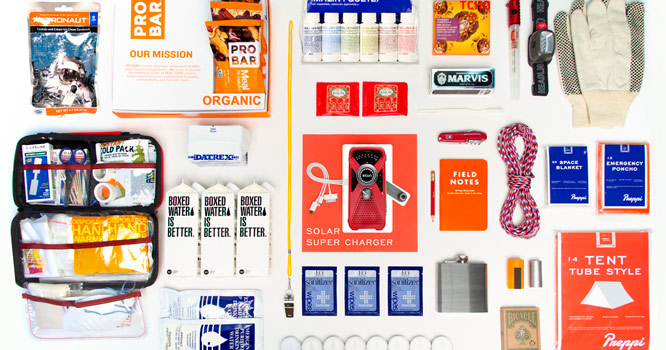
He notices that the new wave of preppers are almost interested in bug-out numberless (mainstream emergency preparedness agencies often call these go-bags), rucksacks packed with a few days' worth of essential supplies. The contents of these bags are hotly debated. "We had 1 guy say that toilet newspaper was a waste matter of time," recalls Wild Nib, "and he but got creamed!" In Guerrilla Warfare, Che Guevara wrote that the well-prepared revolutionary should always accept on hand a burglarize, armament, canteen and cutlery, antibiotics, soap, toothbrush, toothpaste, some inspirational reading, a machete, some gasoline, matches and kindling, needle, thread, and buttons. The modern bug-out bag oftentimes adds to this list a flashlight, radio, hand-crank or solar-powered charging device, a tent, and some mechanism for h2o purification.
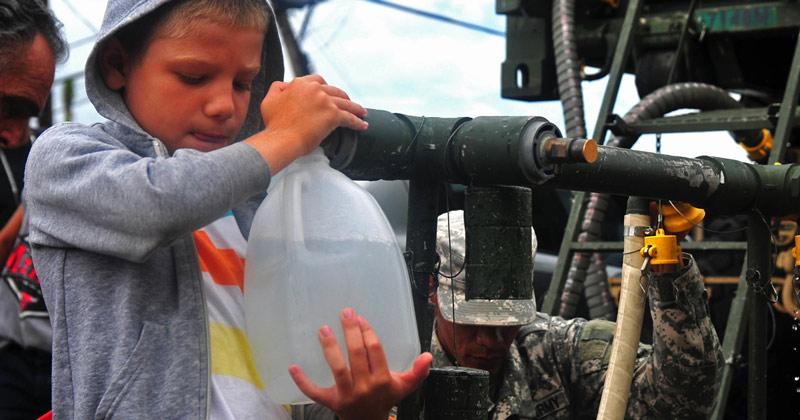
The nightmare situations preppers imagine are already happening—to people whose wealth and status don't protect them. Above, Hurricane Maria relief efforts in Puerto Rico
In December 2017, Faddy featured in its holiday gift guide a handsome sheet apothecary handbag monogrammed with Anna Wintour's initials. But it is no ordinary tote: the bag, from Fifty.A.-based visitor Preppi, is packed with food, water, first-aid items, outdoor necessities similar ropes and flares, luxury soaps and teas, and Mast Brothers chocolate. Preppi started out as a "boutique company," co-founder Lauren Tafuri told a local L.A. blog in an interview, but "2016 was a large year," and the market for their bags has been expanding.
In a Dec episode of the Daily Show, a correspondent presented a packed Preppi purse, the Prepster Black Ultra Luxe Emergency Bag, which retails for $four,995 (this is their most deluxe offer; other pre-packed bug-out options starting time at $95), for inspection by a hard-core survivalist, Rick Austin, who laughed off the smartly designed case and thoughtfully sourced snacks, and fabricated a deadpan comment that in the world after the SHTF, the but liberals around will be dead ones. Preppi founders Lauren Tafuri, a costume designer, and Ryan Kuhlman, a moving-picture show managing director, say this is exactly the kind of attitude they are trying to alter. "Our company intentionally went 180 degrees in the opposite direction of these themes (farthermost/outdoors/zombie apocalypse/fear) nearly commonly associated with prepping. Our customers tend to be modern, connected, and urban dwelling—they are not going to suddenly shed their way of life subsequently an emergency," agreed Kuhlman, pointing out that most emergencies volition not bring about the dawn of a new anarchic age, merely rather, will call for people to crouch down for a few days. "After that most likely you will exist in touch on with emergency responders and services aiding y'all with anything yous may demand." Preppi numberless may lack cred among hard-cadre survivalists, but their growing popularity speaks to the mainstreaming of prepping and the long cultural distance it has traveled.
Prepping has also spread to the uber-wealthy and tech-world elite, with Silicon Valley aristocrats buying bunkers in case they have to GOOD (become out of Dodge). Peter Thiel has gone and so far as to procure an estate in New Zealand—and citizenship to get with it—where he tin can, as Tech Crunch put it, "scout the world burn in peace." Several others told the New Yorker's Evan Osnos they had gotten Lasik surgery so as not to be hampered by blurry vision; in case of societal plummet, one'south contact lens subscription service could be amidst the first civilities to go. Reid Hoffman, investor and LinkedIn co-founder, put the cohort's concerns to Osnos: "Is the country going to turn against the wealthy? Is it going to turn confronting technological innovation? Is information technology going to turn into ceremonious disorder?"
Of course, the nightmare SHTF situations these new preppers imagine are already happening—to people whose wealth and status don't protect them. Low-income individuals and communities of color are far more vulnerable to the consequences of the natural and political disasters we are all already living through. New Orleans's Lower Ninth Ward remained desolate and stripped of services for years afterwards Hurricane Katrina; armed men knocking on doors and stopping cars of people trying to escape unsafe weather at checkpoints is already a reality for undocumented people in the United States.
Disaster preparation doesn't have to be a purely private undertaking that happens at the family or private level. During the early 1960s, landlords took part in what the New York Times called a "fallout shelter bulldoze." The Army Corps of Engineers identified over 17,000 buildings beyond the city, which they "equipped with federally provided survival kits—costing roughly $2.40 per person—that featured aspirin, toilet paper, tongue depressors, appetite-suppressing hard candies and 'Civil Defense force Survival Rations,' i.e., animal crackerlike biscuits." No champagne or artisanal chocolate here, but the plan provided enough infinite to suit nearly 12 1000000 New Yorkers.
Preppers' doomsday scenarios typically hinge on an acute, near cinematic event—the city floods, the bomb goes off, the virus mutates. The crisis is unambiguous, a clear moment at which the old world falls abroad and it's time to batten the hatches or fix off in the mobile hive. What they don't seem to gear up for is the tiresome pitter-patter of social and economic precarity, the erosion of niceties and norms, the sea level inching college so slowly your feet are wet earlier yous realize you ought to have packed a handbag.
Rachel Riederer is editor-in-chief of Guernica.
Source: https://www.dissentmagazine.org/article/doomsday-goes-mainstream-liberal-preppers-silicon-valley
0 Response to "Disaster Prepping American Today Mainstream Again."
Publicar un comentario