Us Customs Prosecutes Family in Texas Over Potato

 The cost of an H-2A visa in Texas
By PATRICIA CLAREMBAUX & ALMUDENA TORAL
Baronial 6, 2020
Curl down to proceed
Workers at a potato processing found in Texas face up abuse by their employers but choose to stay silent out of fear of losing their H-2A visas. Most are unaware they're even victims of forced labor, or that the fees they're required to pay to their supervisors for a visa are illegal. They don't trust the government either, and fear retaliation for speaking out. Information technology'south a reality faced past some 36,000 people a year in this edge state.


This project was supported past The International Women'due south Media Foundation and The Carter Center.
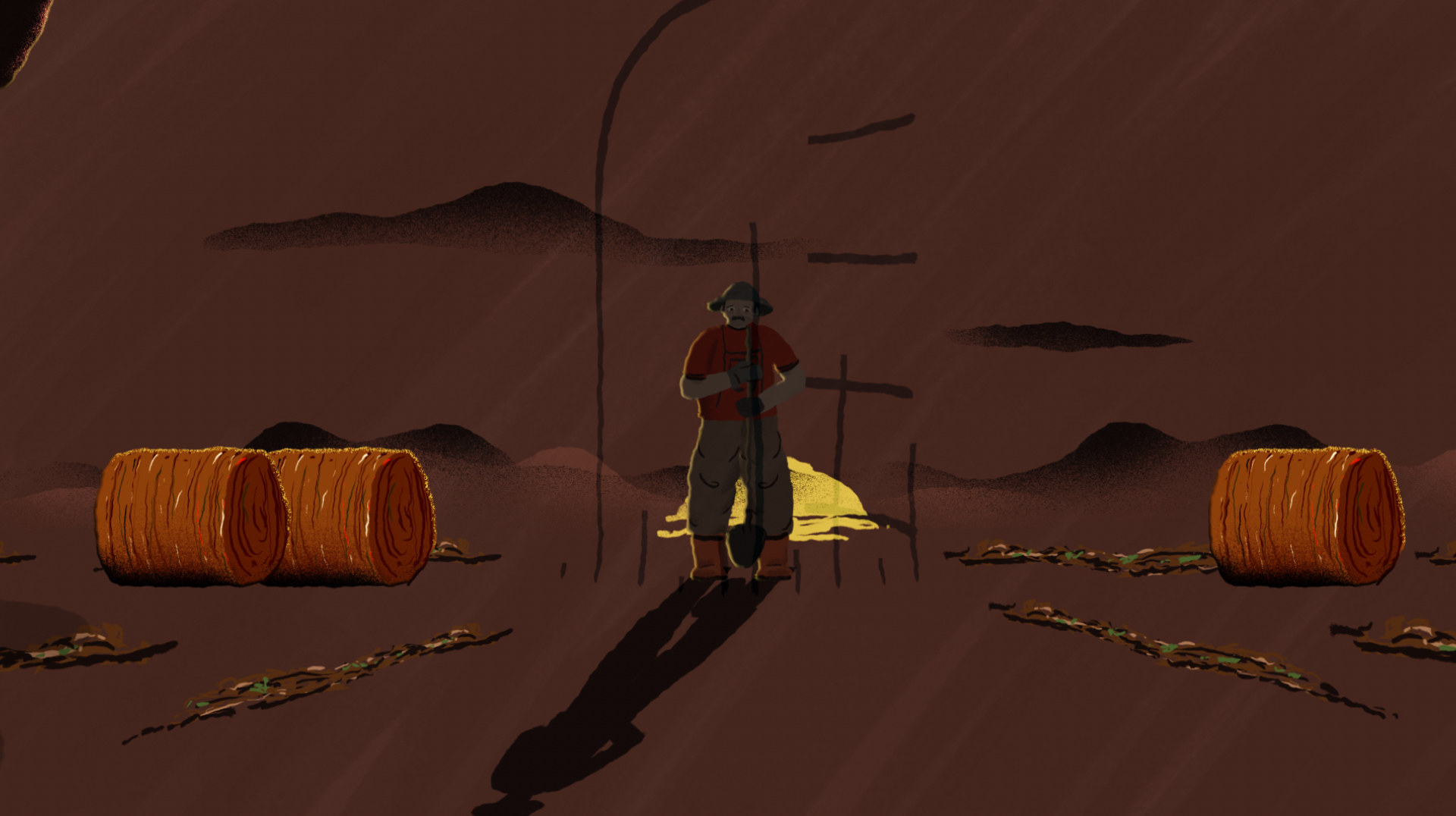
Pablo suffered through endless hardships to avert losing his temporary work visa and job at a potato plant in Dalhart, in the Texas Panhandle. Ane 24-hour interval, he said his boss, Xavier López Palacios, hitting him so hard in the leg that he was left with a limp. On others, Pablo was pressured repeatedly to piece of work faster.
Palacios, who was in charge of the warehouse until June, also shouted insults at Pablo and threatened to telephone call immigration agents to behave him; under strict orders, Pablo worked up to 22 continuous hours. One time he was so tired that he accidentally fractured his paw. In spite of the doctor's orders, López Palacios —who has denied the aforementioned accusations—wouldn't allow Pablo to rest, he said.
Pablo's name has been changed and some of his personal details were omitted to guarantee his and his family's safety, and to avert retaliation.
Pablo'south state of affairs is non unique. Each year, thousands of Mexican and Fundamental American immigrants feel forced labor in the United States. According to the International Labour Organization, this can exist understood as work that is "performed involuntarily and under the menace of any penalty." It refers to situations in which "persons are coerced to piece of work through the use of violence or intimidation, or by more than subtle means such as manipulated debt, retention of identity papers or threats of denunciation to immigration regime." It'southward considered a mod form of slavery.
A study conducted past the University of Texas at Austin estimated that in 2016 there were approximately 36,970 immigrants beyond the state working in conditions similar to those Pablo has faced. Through illegal means, such as collecting fees, operators deducted more than $94 1000000 from workers' checks and salaries, the study said.
Co-ordinate to the written report, the number of victims is likely much college, simply the majority of those affected don't speak out. They suffer in silence, agape of being turned over to government who could mountain a case confronting them and gild their return to the poverty and danger of their dwelling house countries.
These workers live in fear, every bit if they had no rights—all considering their work visas are granted by an abusive employer.
"I never knew what I'd have to get through to earn money," Pablo says. "We endure everything: mistreatment, insults, all for the well-being of ourselves and our families. And it's non fifty-fifty to live super well; merely to provide a little bit more for our families."

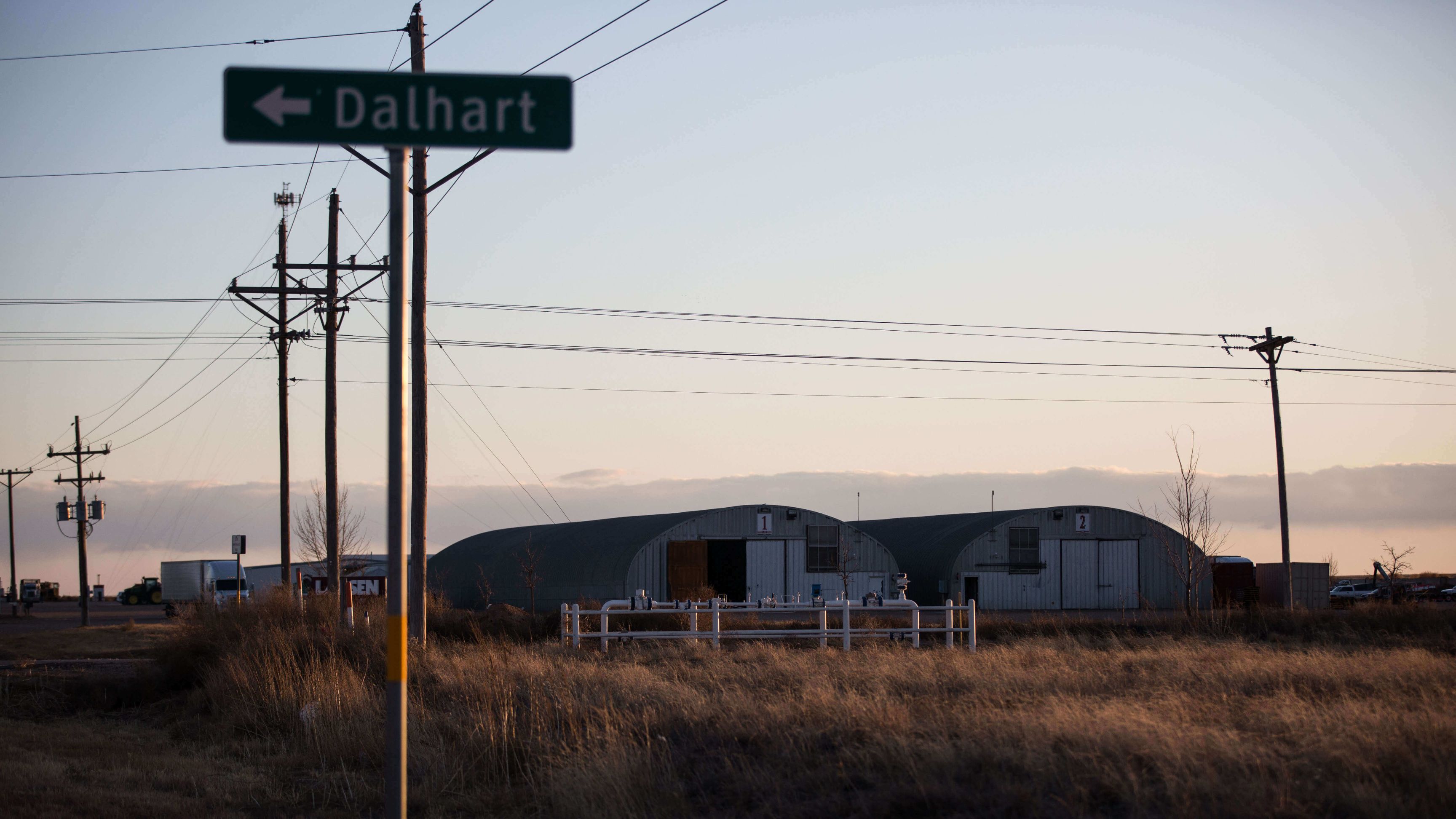
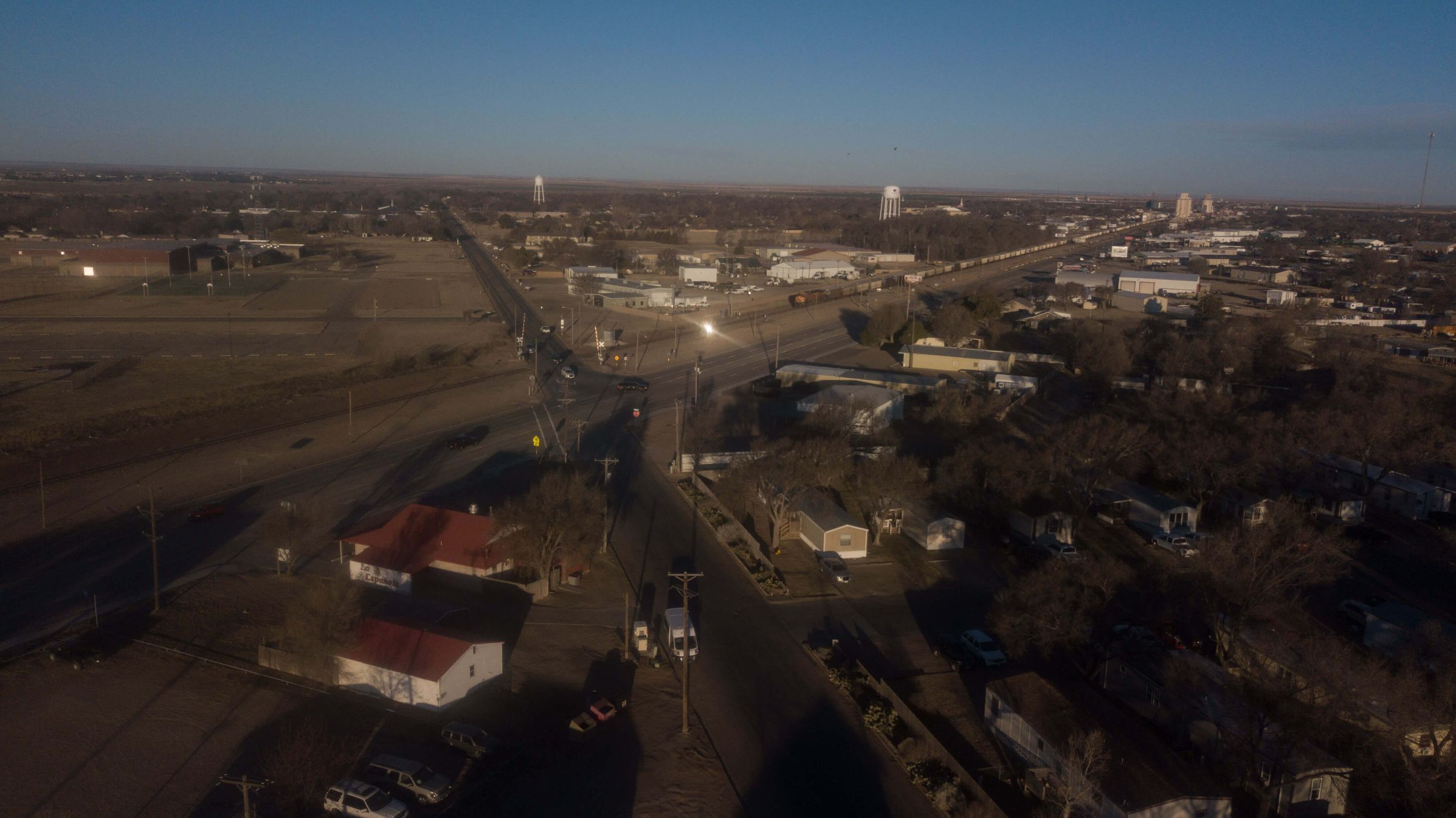
Dalhart is a pocket-size city of merely over 8,000 residents. The largest share of the population is white, followed by Hispanics.
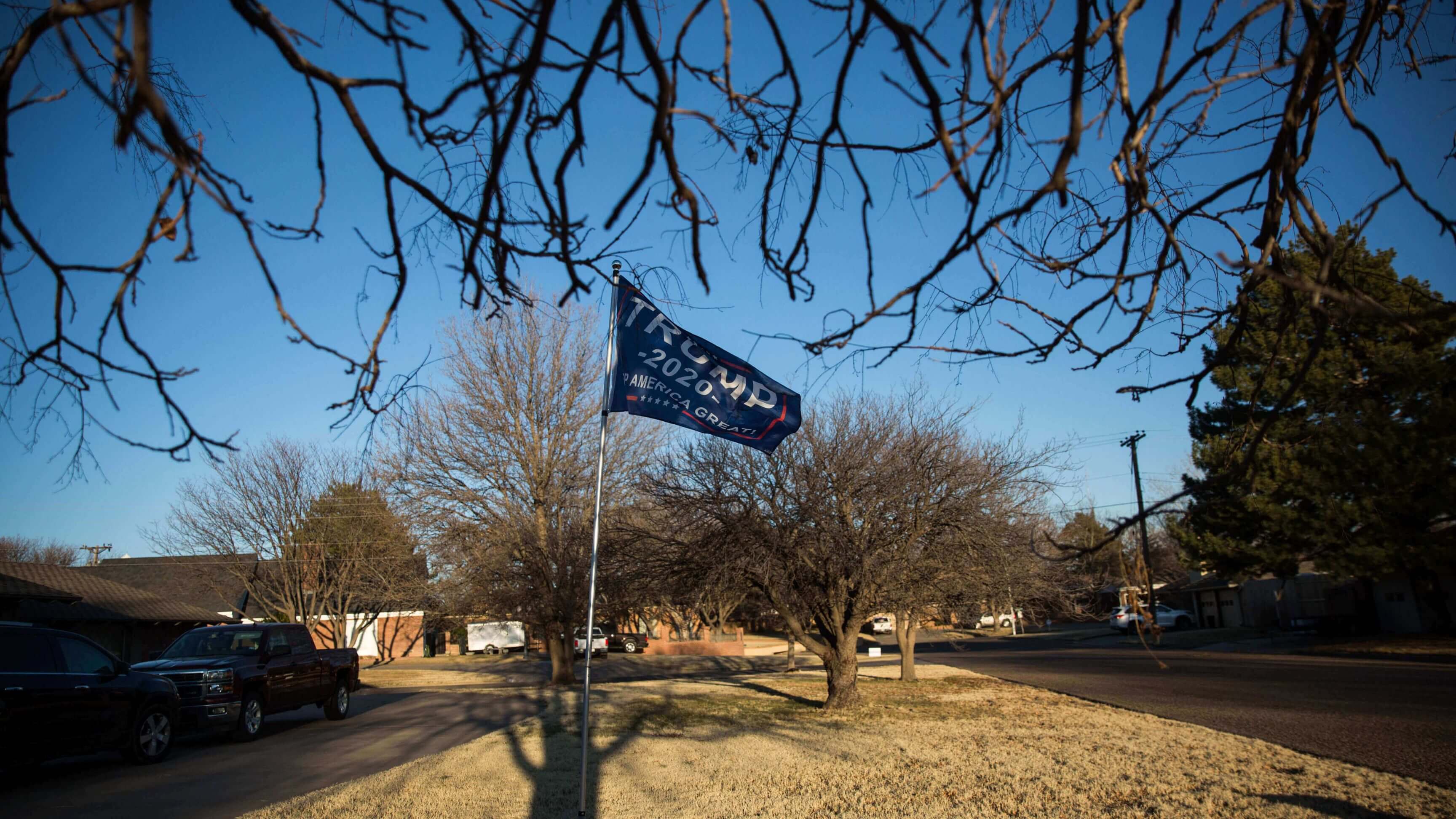
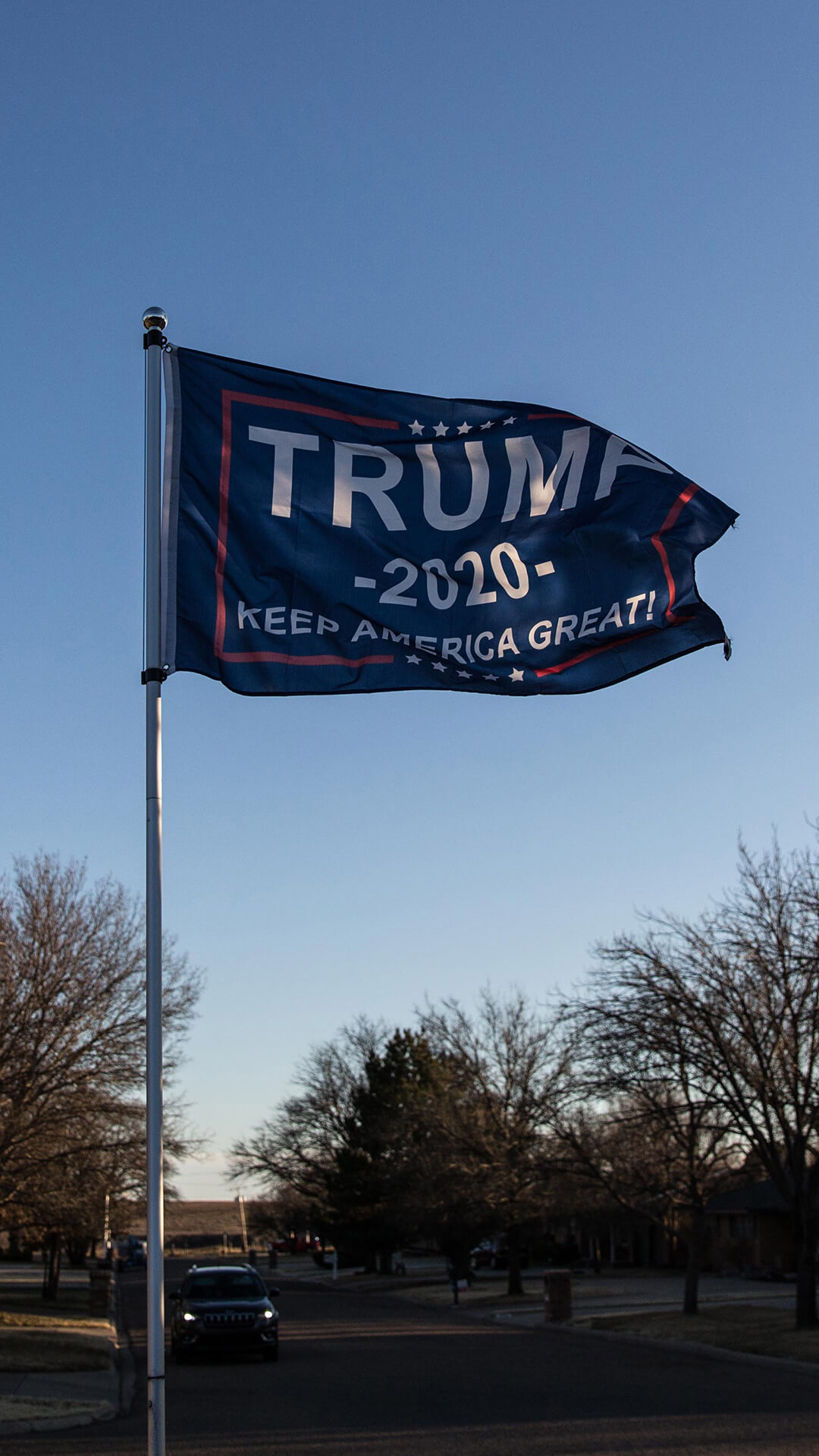
More than lxxx% of voters hither cast ballots for Donald Trump in the 2016 presidential ballot.
Dalhart has few streets, and most are empty. There are more than laundromats and motels than restaurants; there's a single supermarket and a main artery, Railroad Street, where the majority of the town's activity takes place. It has a McDonalds, a Dairy Queen, a Wendy's and a Sonic drive-in.
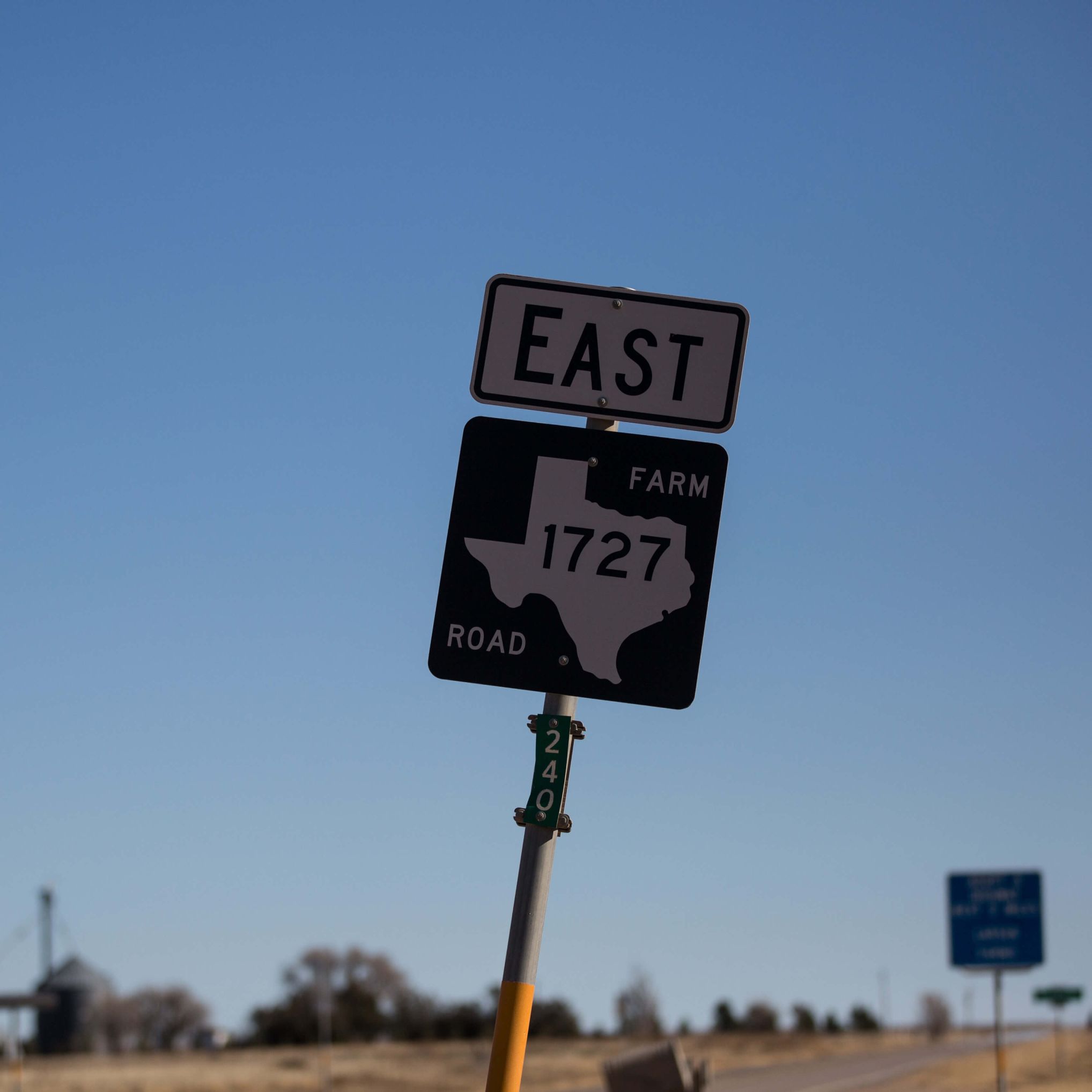
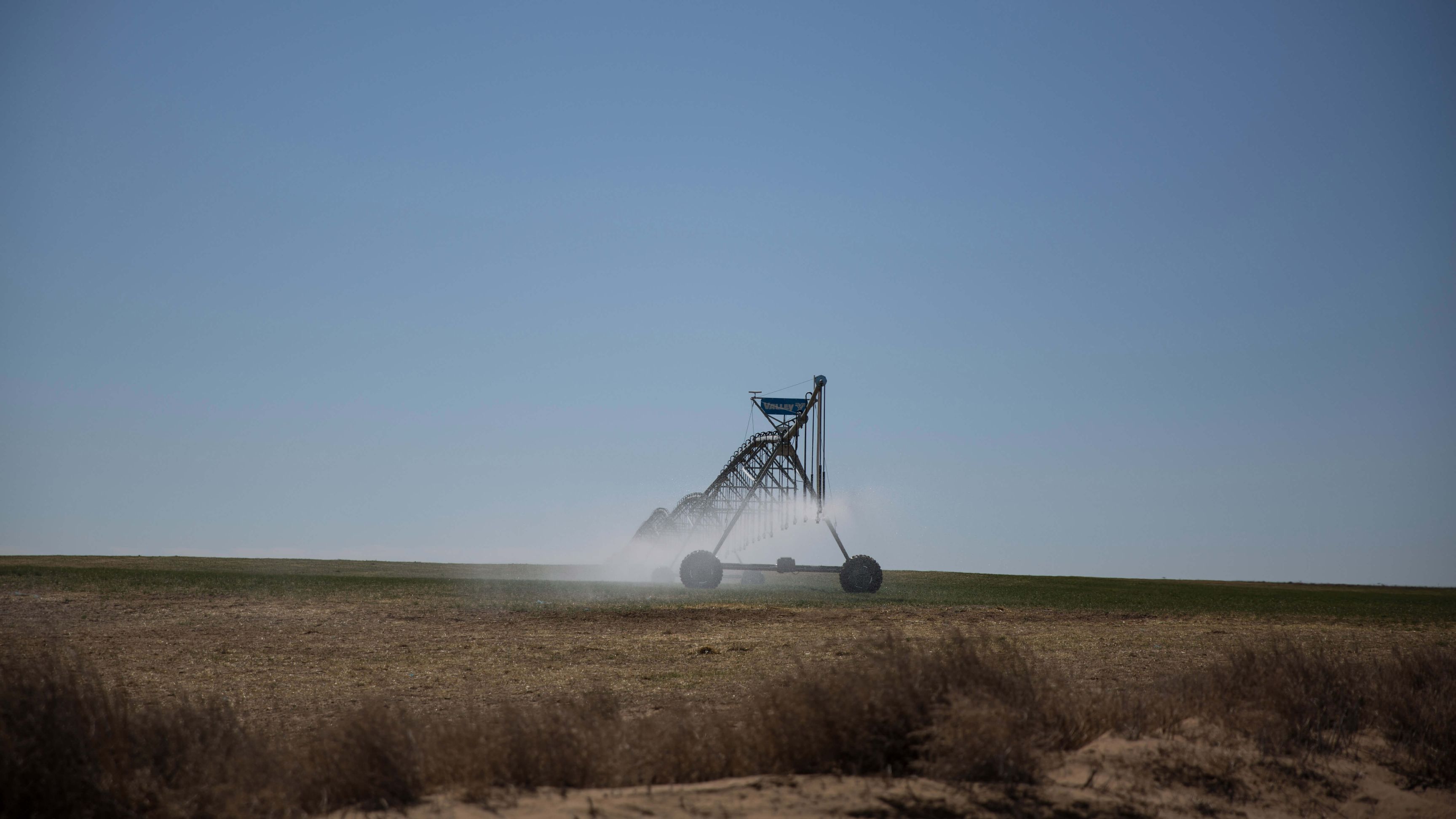
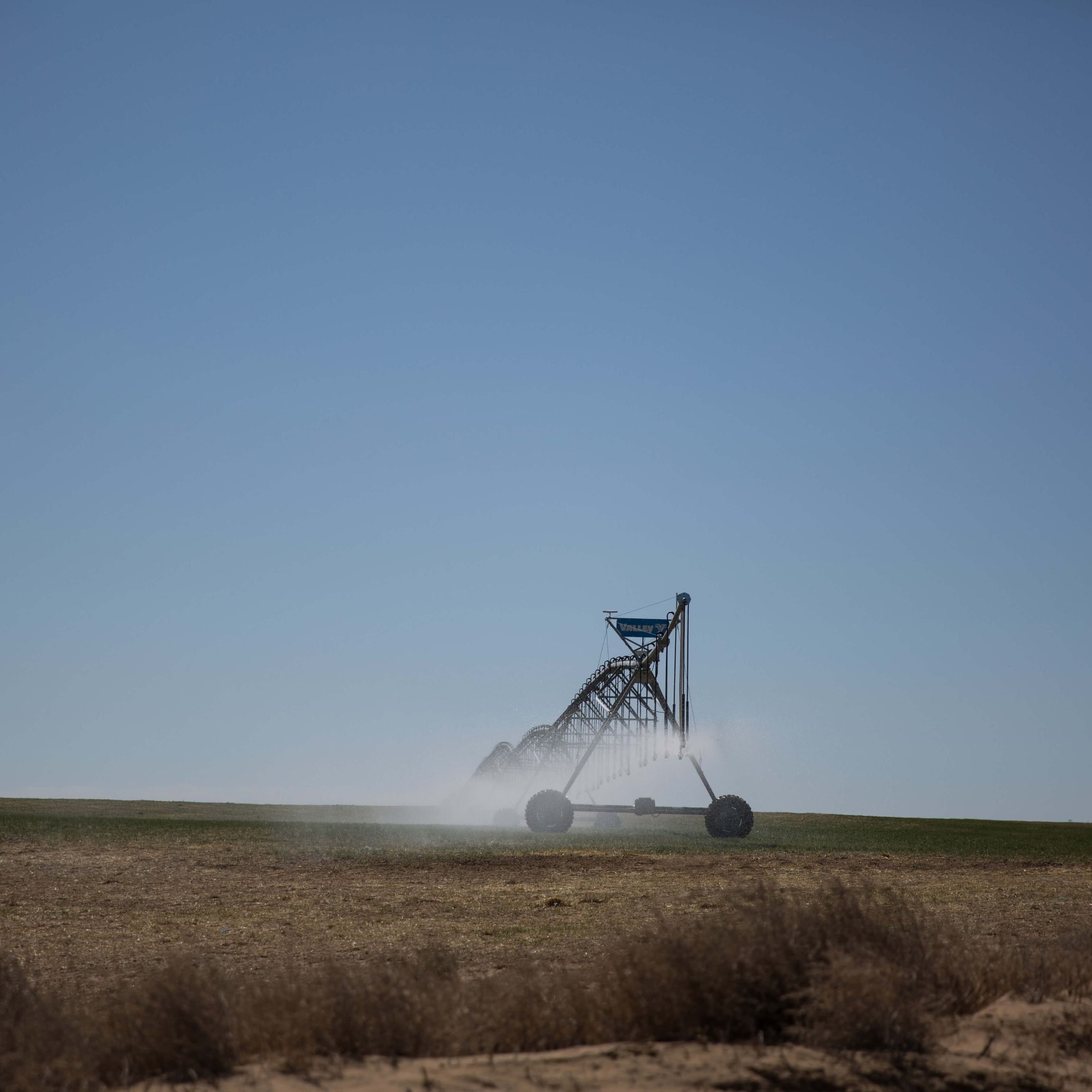
At the edge of town, the mural transforms into endless plains, reached merely by dirt roads.
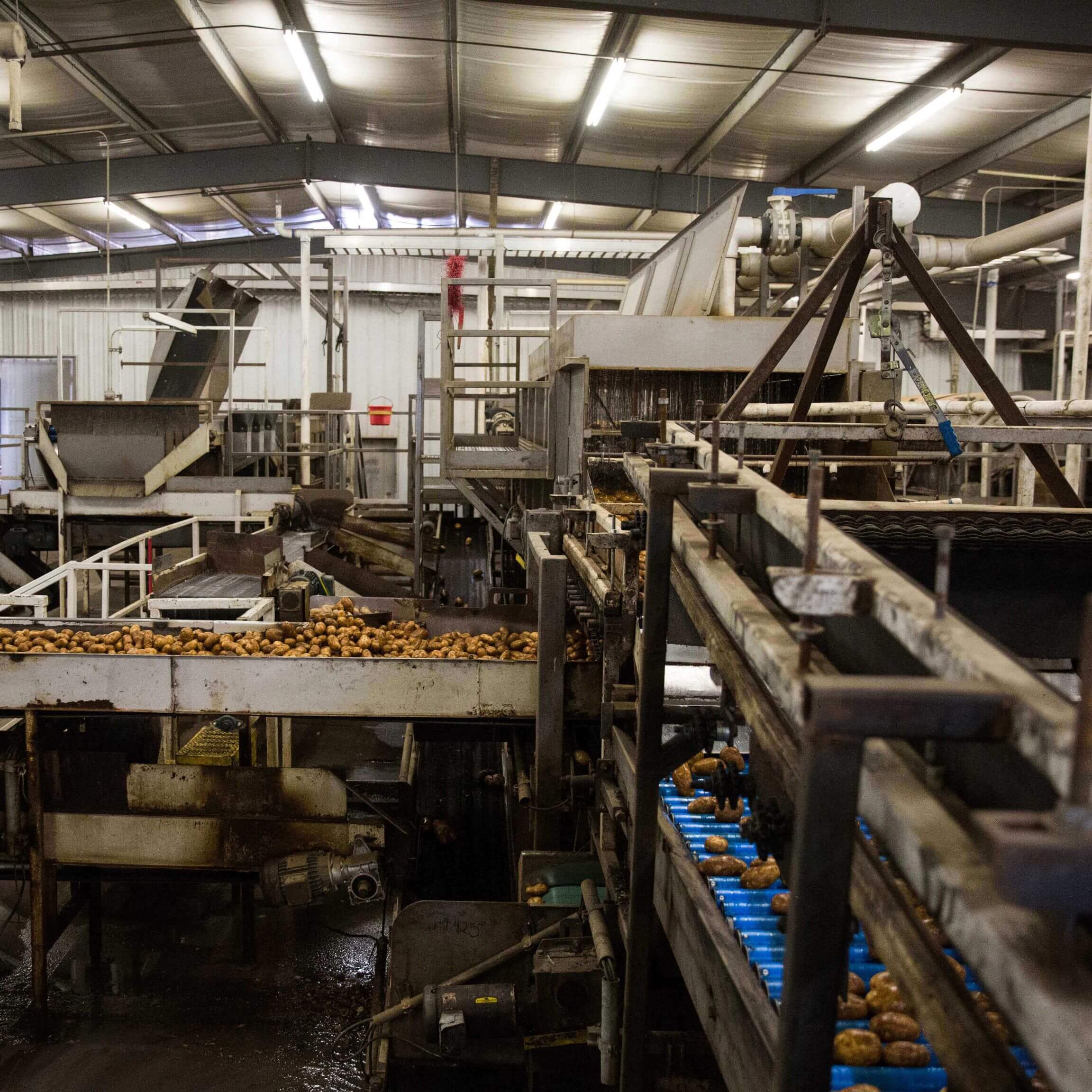
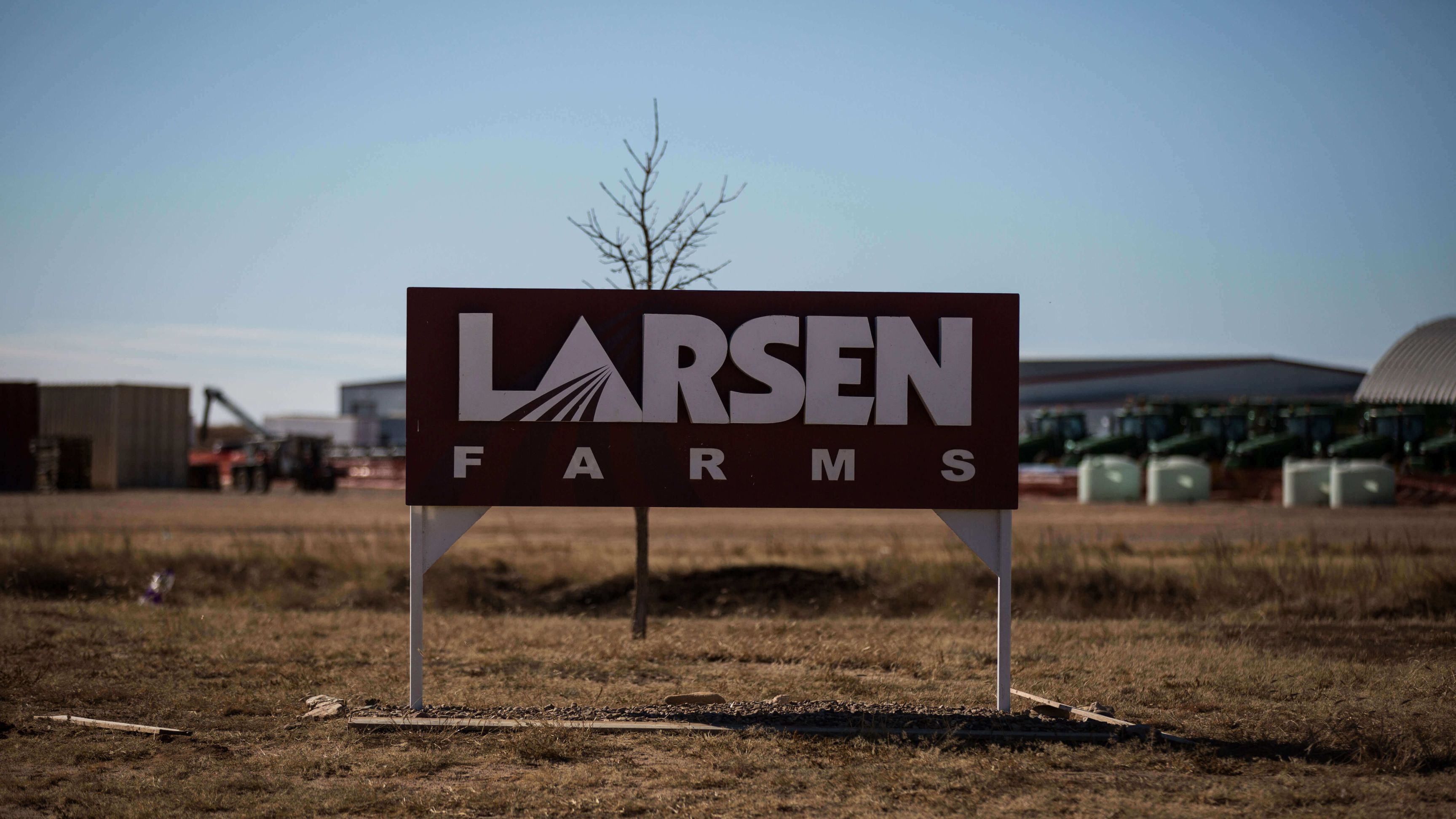
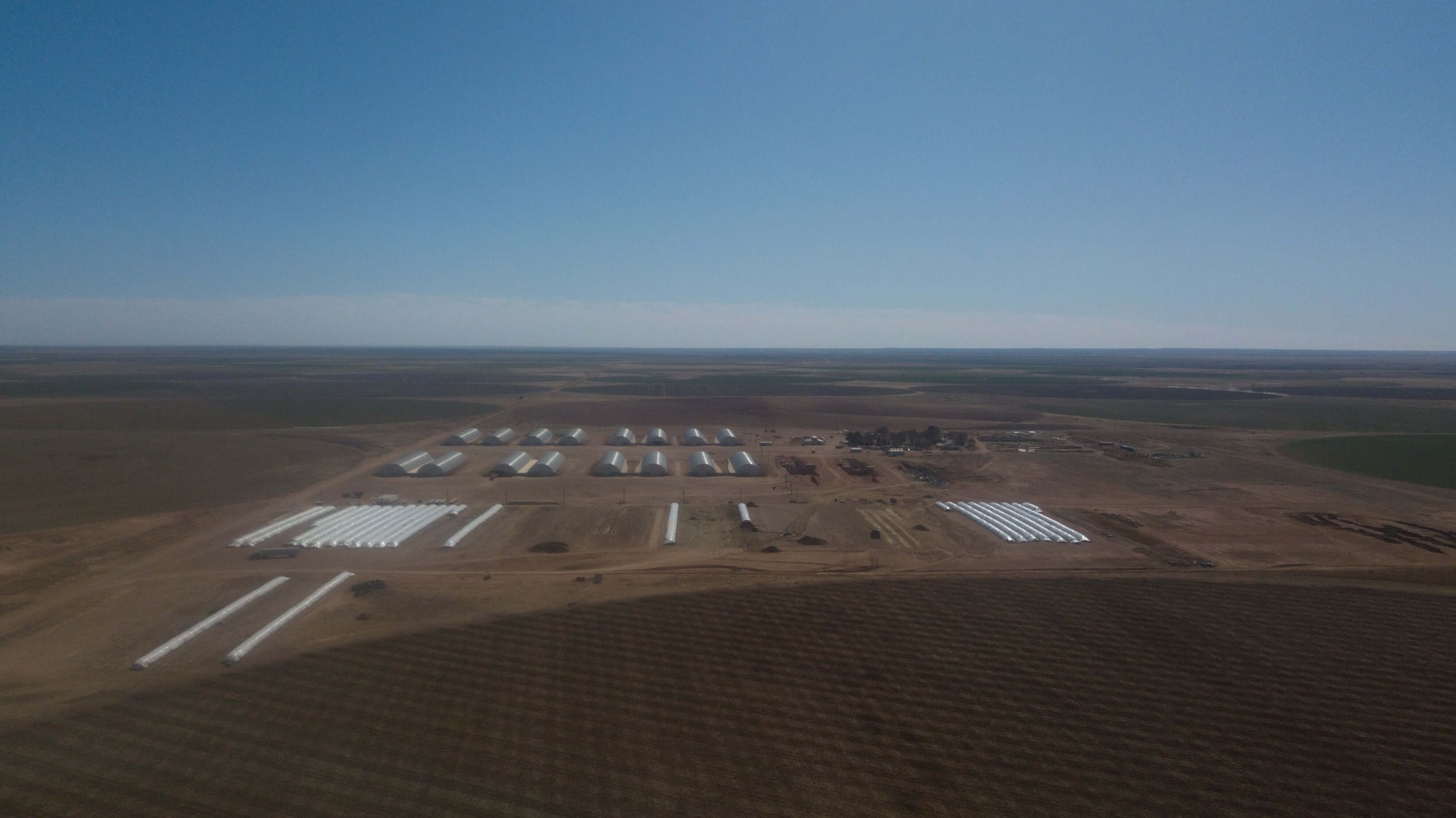
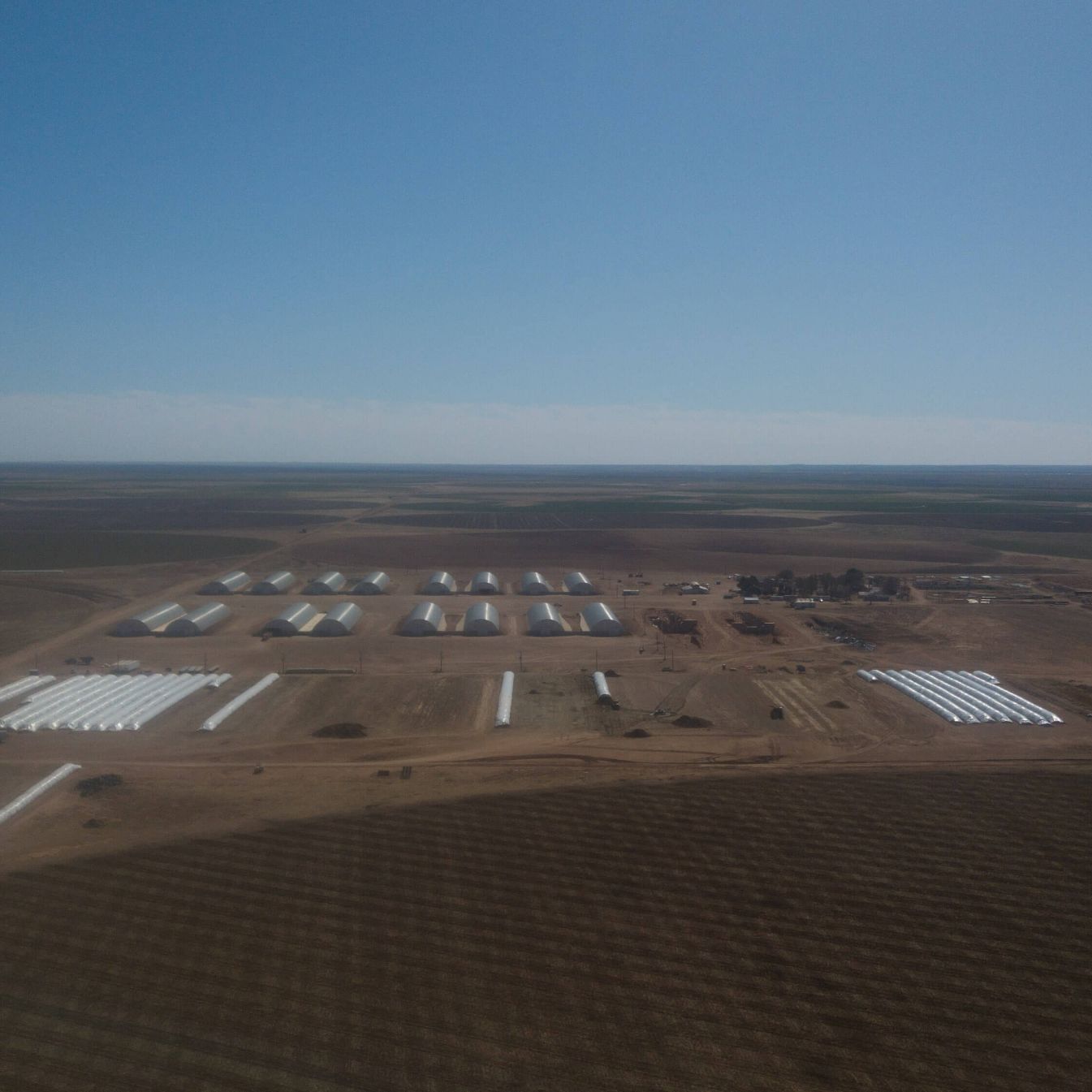
At the end of 1 of those dirt roads, about a half-hour drive from town, sits the 37,500 acres of land owned by Larsen Farms, 1 of the largest potato producers in the United States, founded in 1966. The farm supplies potatoes to a large chunk of the country, with sales of betwixt iv and five million numberless a year to retailers like Walmart.
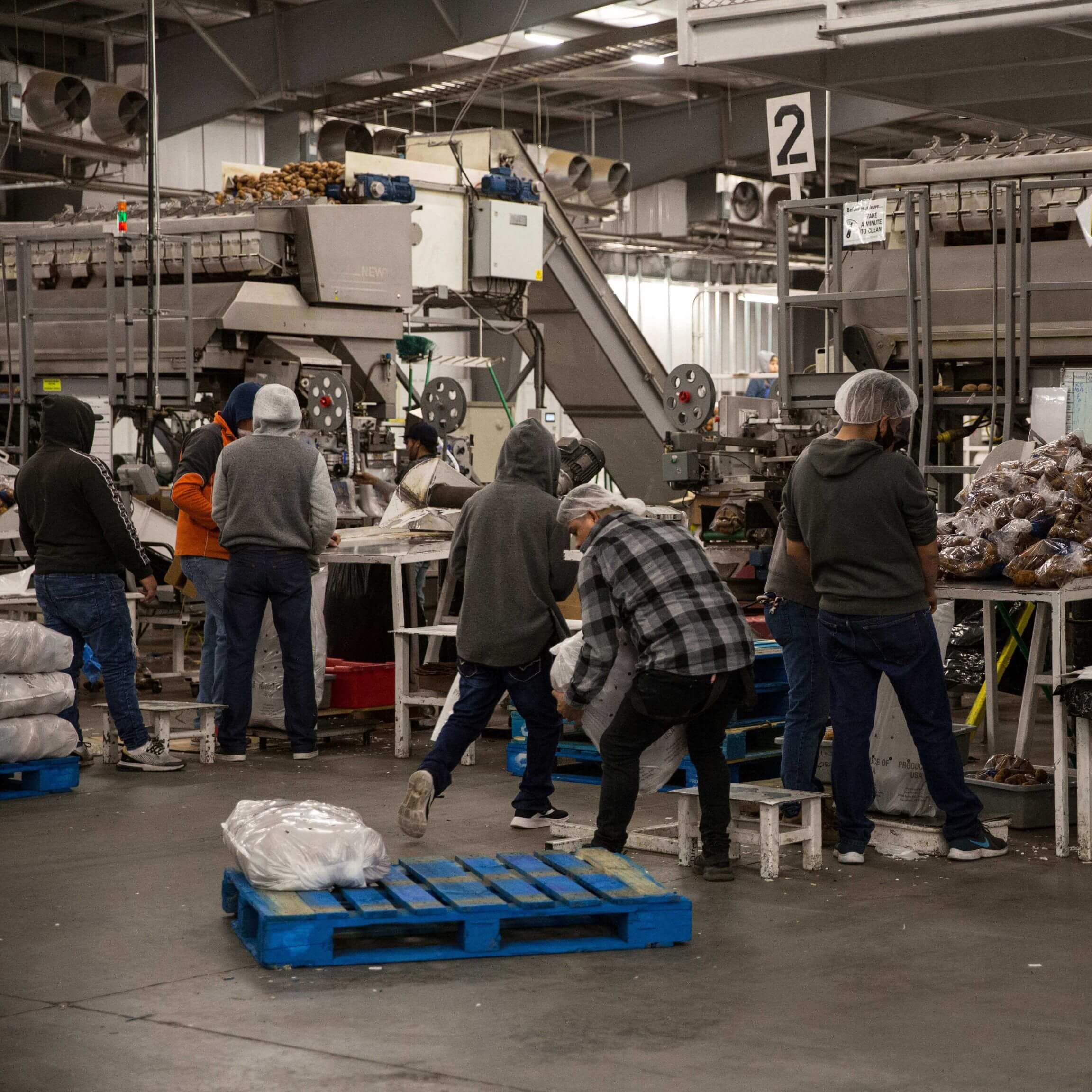
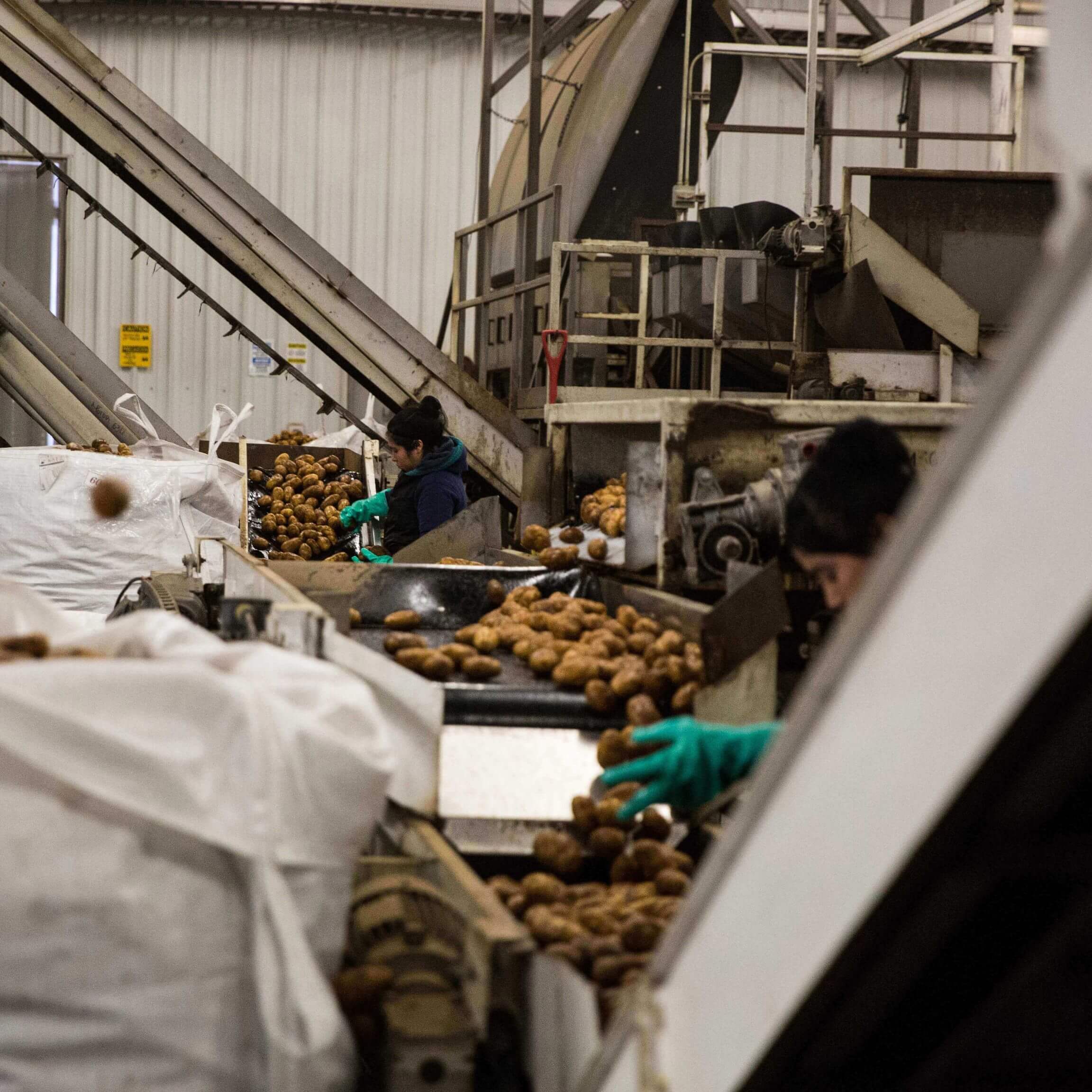
This is where Pablo works alongside some 300 others each yr in the months between March and Oct, when land is prepared and planted. Similar him, more than seventy% of his colleagues are Mexicans brought by the company with temporary H-2A visas. They are the cadre workforce of the company.
The rest of the employees are Hondurans, Guatemalans and Mexicans who live in Dalhart. Many of them are undocumented and use fake social security numbers to get work.
Some are teenagers.
More than a dozen people interviewed by Univision Noticias betwixt November and July—with and without visas—say they suffer or suffered abuse at the hands of the supervisors at the company. Its president, Blaine Larsen, an American who lives between California and Idaho, admitted to Univision that he had heard such complaints for years, merely was never able to verify them.
Since Univision began reporting this story, federal authorities accept made multiple arrests, implicating supervisors at Larsen Farms including José Ramón Huaracha Escamilla on crimes including fraud in foreign labor contracting and conspiracy to commit fraud in strange labor contracting. Palacios was also detained, defendant of fraud and misuse of visas, permits and other documents.
Pablo first came to Larsen Farms on the recommendation of an acquaintance. "He asked if there was an opportunity for me," he says. "That'south how a lot of workers got jobs: people who were already working there sought out opportunities for them."
Another company supervisor charged Pablo more than than $1,000, alleging that it was a kind of "fee" for the visa. "Nosotros are going to lend you lot a manus," Pablo recalls being told by José Ramón Huaracha Escamilla over the phone before traveling to the United states of america.
In render, Pablo had to pay in underground. "Do you want the job or not?" he remembers being asked.
He accepted. "Who would say no to the opportunity to come piece of work hither? Everyone knows people are charged for visas, we just stay tranquillity most information technology."
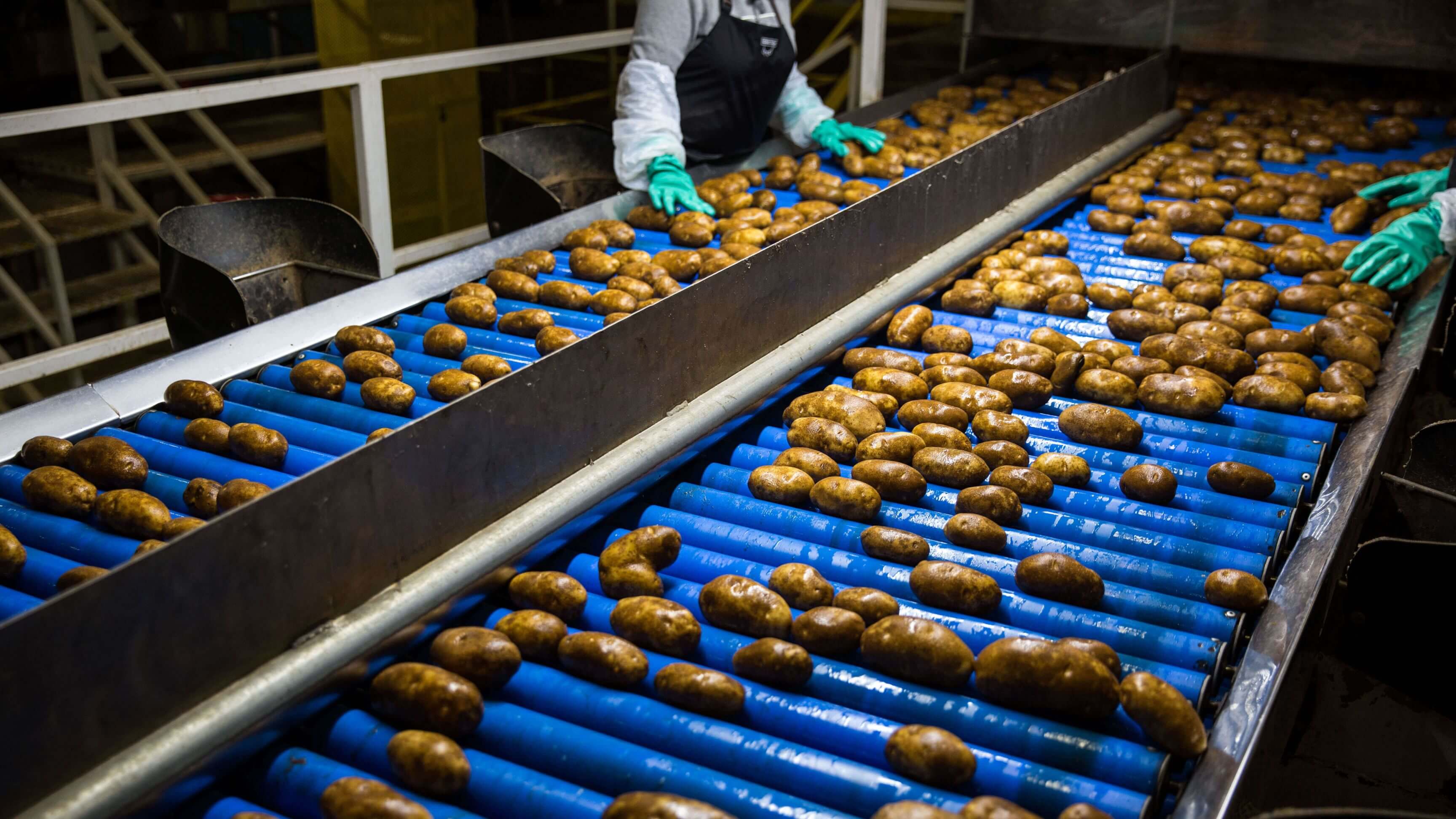
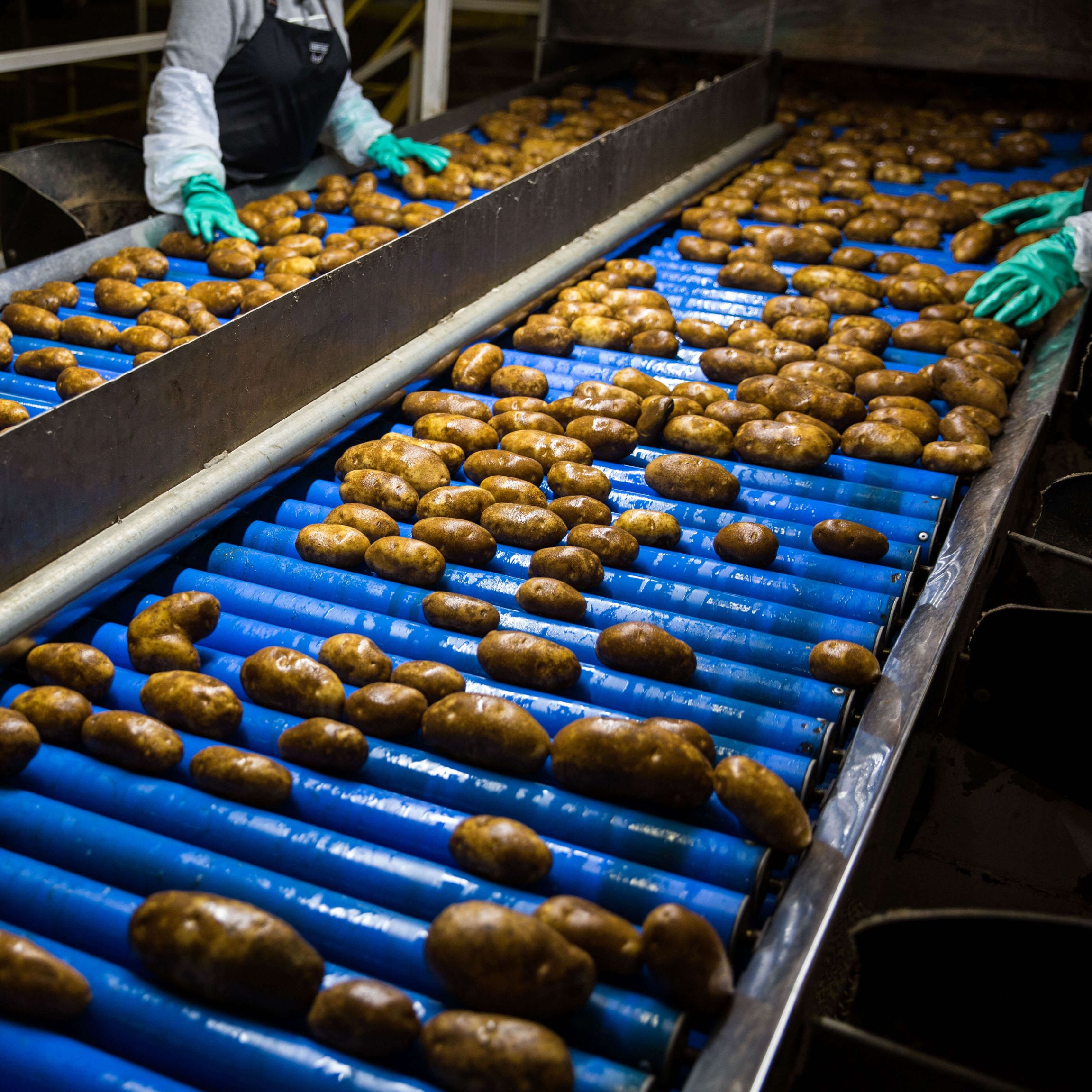
Once he was working in Dalhart, Pablo says that he was forced to hand over role of his bank check to José Ramón Huaracha every two weeks. Another portion went to Mexico to support his wife and children; he also paid a monthly "quota" of hundreds of dollars to a criminal in Mexico and then that he wouldn't harm his family.
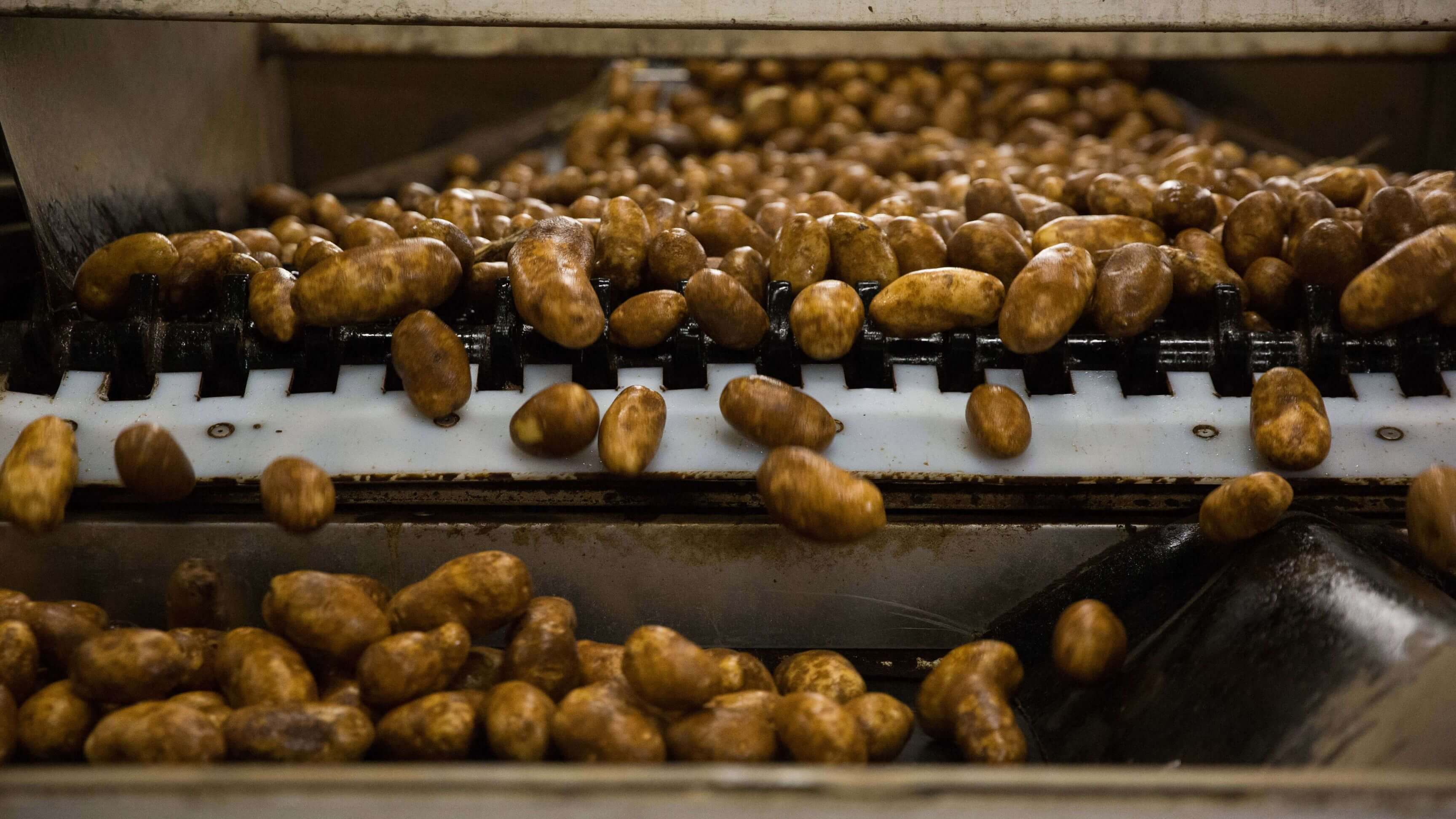
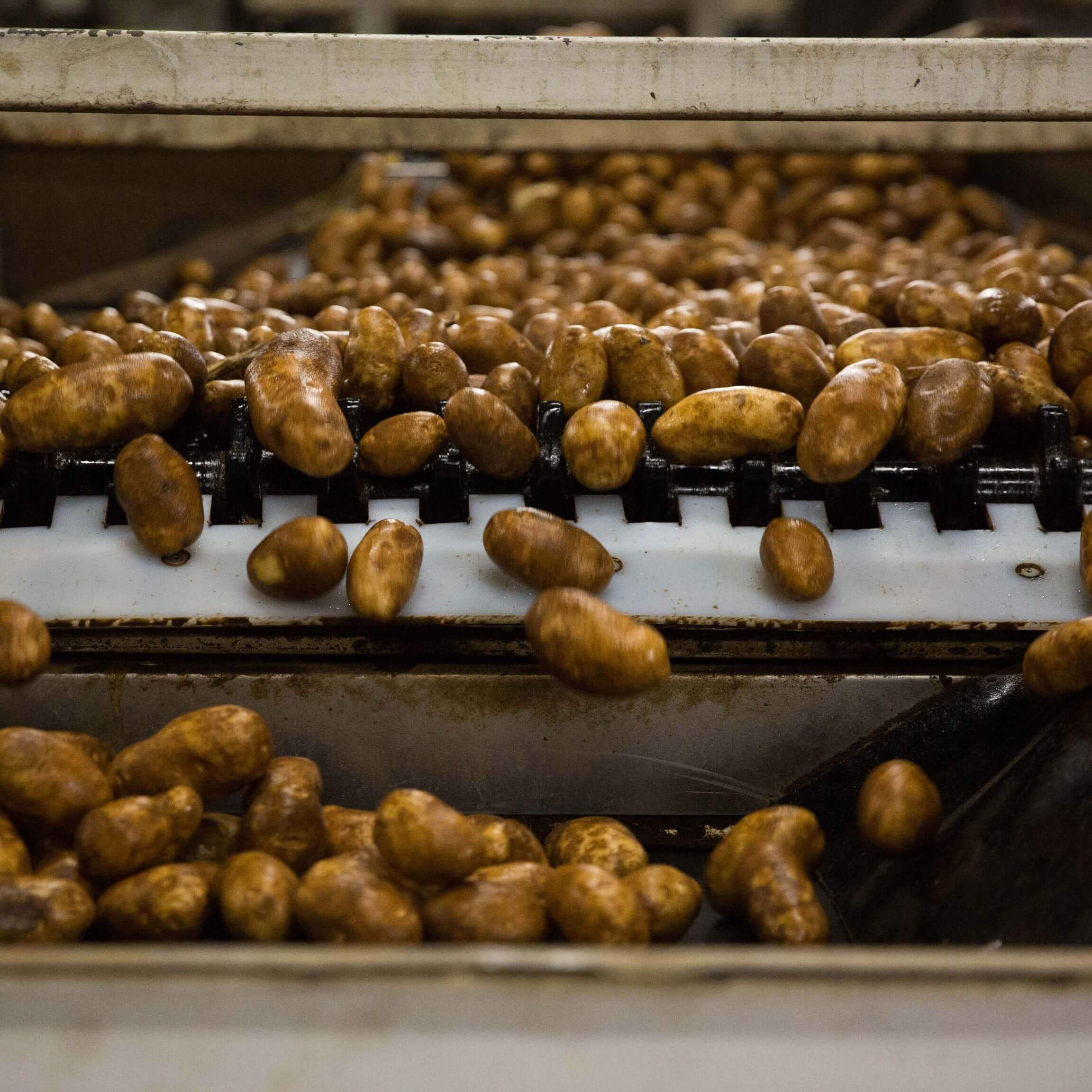
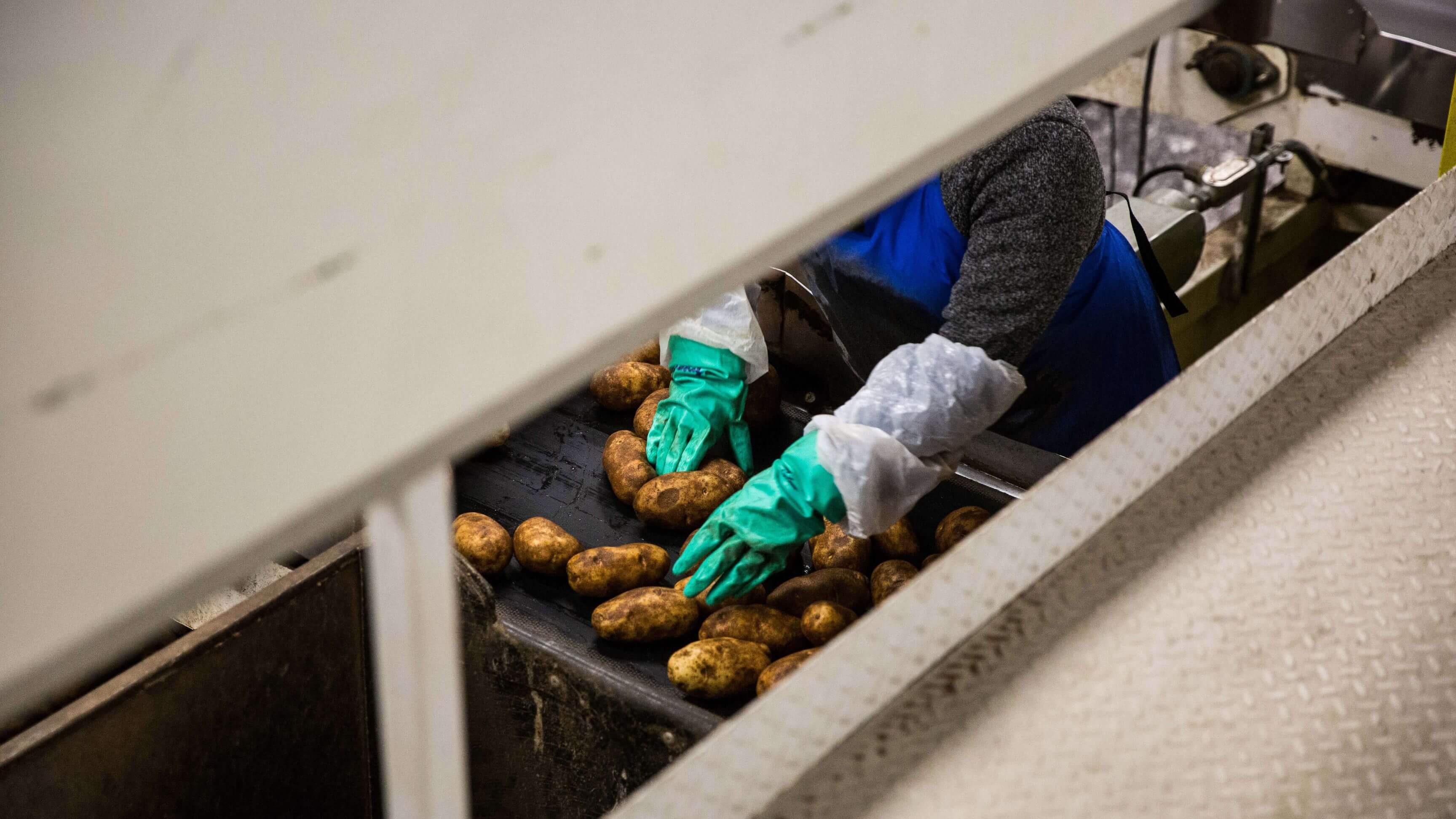
Workers sort potatoes at Larsen Farms. Almudena Toral/Univision
Many workers come from areas dominated by drug cartels and also pay additional fees to protect their relatives in Mexico.
José Ramón Huaracha is the brother of Antonio Huaracha, who since December 2015 has been the general manager of Larsen Farms in Dalhart. In 2011, Blaine Larsen himself transferred the brothers from the Idaho headquarters to Texas to institute and operate the new plant.
Other members of the Huaracha family likewise work for the company: their father is a tractor driver and three more siblings work for the visitor; one is in charge of the trucks, another is an operator and sometimes works the country and a tertiary performs back up and monitoring functions in the field.
Rebecca Guerra, Larsen's quondam human resources manager, says that a culture of "corruption" and "favoritism" imposed past the Huaracha family prevails at Larsen Farms. They decide who is hired and who receives privileged treatment. "You take to accept the final proper name Huaracha to be accustomed or you lot have to be well known to them in order to be someone," she claims.
 Antonio (2nd to the left) and José Ramón Huaracha (first to the correct) in a family photograph. Source: anonymous.
Guerra'south position allowed her to communicate constantly with employees. She says she spoke with at least five workers who had H-2A visas and were accustomed into the company on the aforementioned terms as Pablo. In all cases, payment was made to the same supervisor, José Ramón Huaracha, in amounts between $1,500 and $four,000.
Guerra explains that she met with employees outside the company for fear of retaliation, who told her how the visa payment scheme worked: "They begged me not to tell anyone," she says. "I wanted to report it, but I was scared, thinking that [José Ramón] would punish or threaten me. So I never said annihilation."

She says she also reported abuse to Antonio Huaracha, but that the complaints were ignored. "They didn't want to listen, they always had an excuse."
In April 2020, Univision informed the company in writing of the allegations against José Ramón Huaracha collected during viii months of investigation and employee interviews, and requested an interview. A calendar week after learning of the allegations, Larsen traveled to the Dalhart processor and contacted Univision.
"Ramón resigned, he is no longer with the company," Blaine Larsen said during a telephone interview on Apr 23, 2020, calculation that he was "shocked" to larn the details of the accusations against one of his Dalhart supervisors.

He explained that José Ramón Huaracha had resigned four days earlier, on April xix, after denying the allegations. "If I can prove information technology, I will sue Ramón," Larsen said.
In an April 24 interview with Univision, José Ramón Huaracha explained that beginning in 2017 he oversaw the lists of people who came to work for the company from United mexican states nether the H-2A visa program, and he was also the farm and field operations manager. He recorded the names of people "recommended" by managers or other employees: "To those who gave me names, I would say: 'If this person isn't good or performs poorly, are you willing to lose your job?' Many agreed, others backed out."
Later on, José Ramón Huaracha would speak to applicants over the phone, asking them if they had the skills to do the task well. He would tell them: "I trust your word, but we'll see if y'all tin earn your go on or non," he said.

He denied detailing the terms of the hire or request for extra payment to include a worker in the list of H-2A workers for the season, declaring to Univision: "That is a lie."
On the contrary, he said that there were times when the applicants themselves offered him coin. "The people of Mexico accept offered [me] a lot of money," he said. "There are people who came to speak to me and offered me the same amount they'd paid a coyote to bring them to the U.S. I never took money, I never charged anyone."

Amidst accusations from employees and old employees that point to him as being at the forefront of the sale of visas at Larsen Farms, José Ramón Huaracha resigned in a handwritten alphabetic character to the human resources section. He said he did non salvage a copy of the letter: "I said I was resigning considering they were speaking unjustly virtually me and because I wanted to be with my family unit."
That same twenty-four hour period, he visited the homes of a number of Larsen Farms workers with ii other supervisors, including i of his brothers, to inform them of his resignation. According to diverse sources, he fabricated one last threat: "If you speak, it won't go well for you."
José Ramón Huaracha denied that he intimidated or threatened employees that 24-hour interval. "I spoke to people and told them clearly: 'I am going to stop working with Larsen, and I'grand leaving Larsen because of these reasons and this is not true,'" he said. "I told them: 'I am leaving, you accept to piece of work hard to keep your jobs, because I'k non going to be there anymore.'"

In early May 2020, the Justice Department contacted Univision regarding charges beingness filed by the bureau against José Ramón Huaracha. On July 21, a criminal complaint against him was made public. He was accused of fraud in the hiring of foreign workers and conspiracy to commit fraud from February 2018 until at least June 2020. An arrest warrant was issued against him and he was arrested that 24-hour interval.
The document explains that special agents in charge of the investigation—from the Labor Department—interviewed seven employees and former employees of the company betwixt May 27 and June 18 who described a "pay to play" scheme used by José Ramón Huaracha to collect between $one,000 and $one,500 from each worker to be included in the list of those hired with H-2A visas.
"Huaracha, his family members in Mexico and other surrogates of his choosing approached prospective H-2A recruits in United mexican states and current H-2A workers on the chore at Larsen Farms to tell them that they would demand to pay Huaracha to get their names placed on a list Huaracha controlled that was used past Larsen Farms to obtain names of workers for the purpose of sponsoring them for H-2A visas the next farming season," the complaint reads. Information technology also states that the only workers who did not accept to pay the fees were members of Huaracha's family.
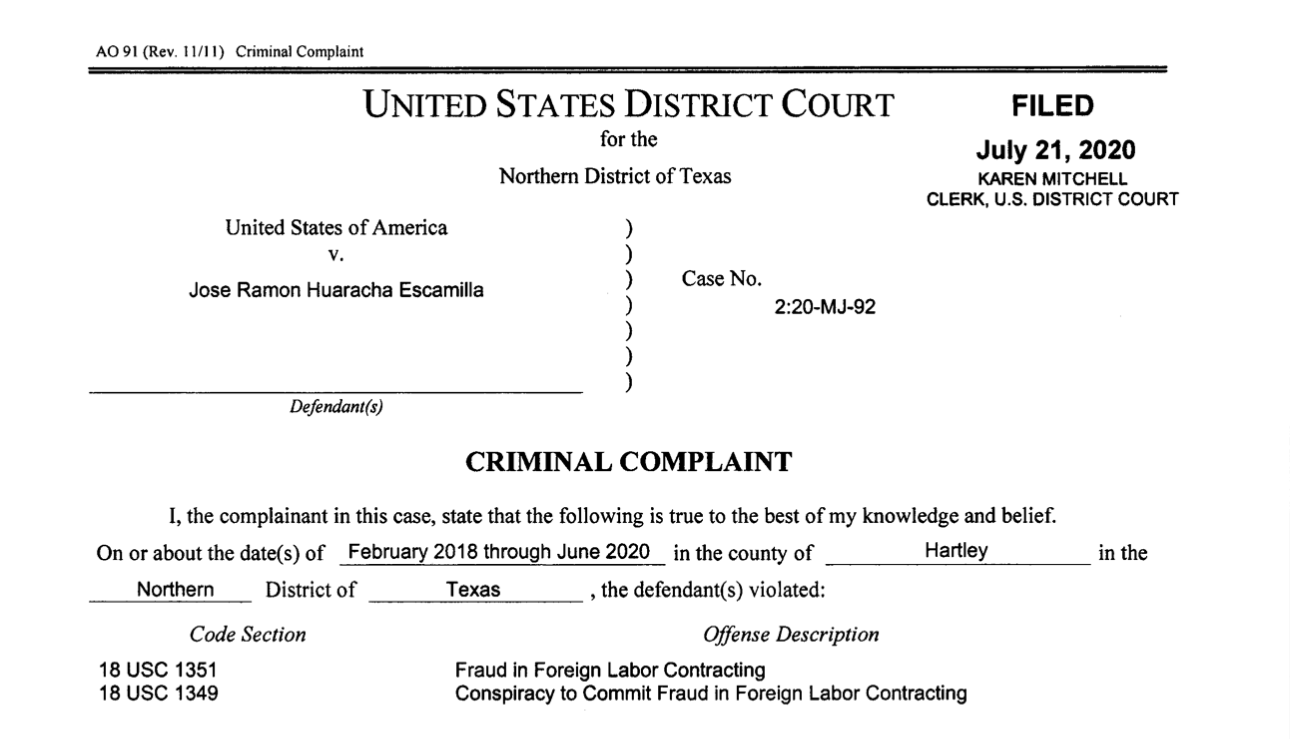 Part of the get-go folio of the criminal complaint against José Ramón Huaracha.
Erin Nealy Cox, U.S. chaser for the United States District Court for the Northern District of Texas, told Univision that Huaracha after pressed workers to "continue the $i,000+ payments hole-and-corner, both from Larsen Farms and from federal constabulary enforcement," which "violated the laws surrounding the H-2A program."
Guerra, the former human resources manager, was among those interviewed by investigators from the Labor Department. According to the complaint, she told them she believed Huaracha charged half the fee when workers were nonetheless in United mexican states and the rest once they were brought to the U.s. with their visas.
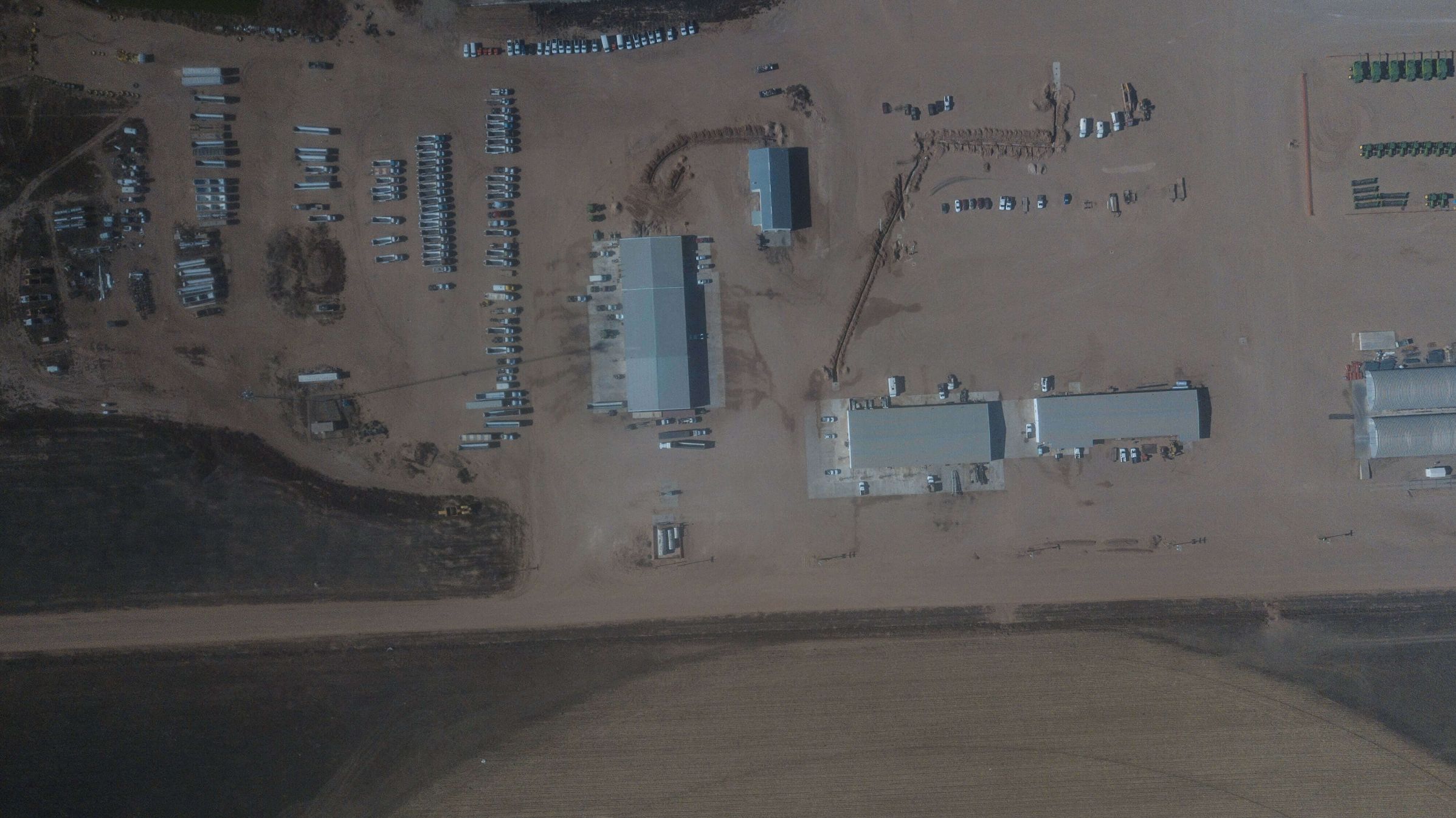
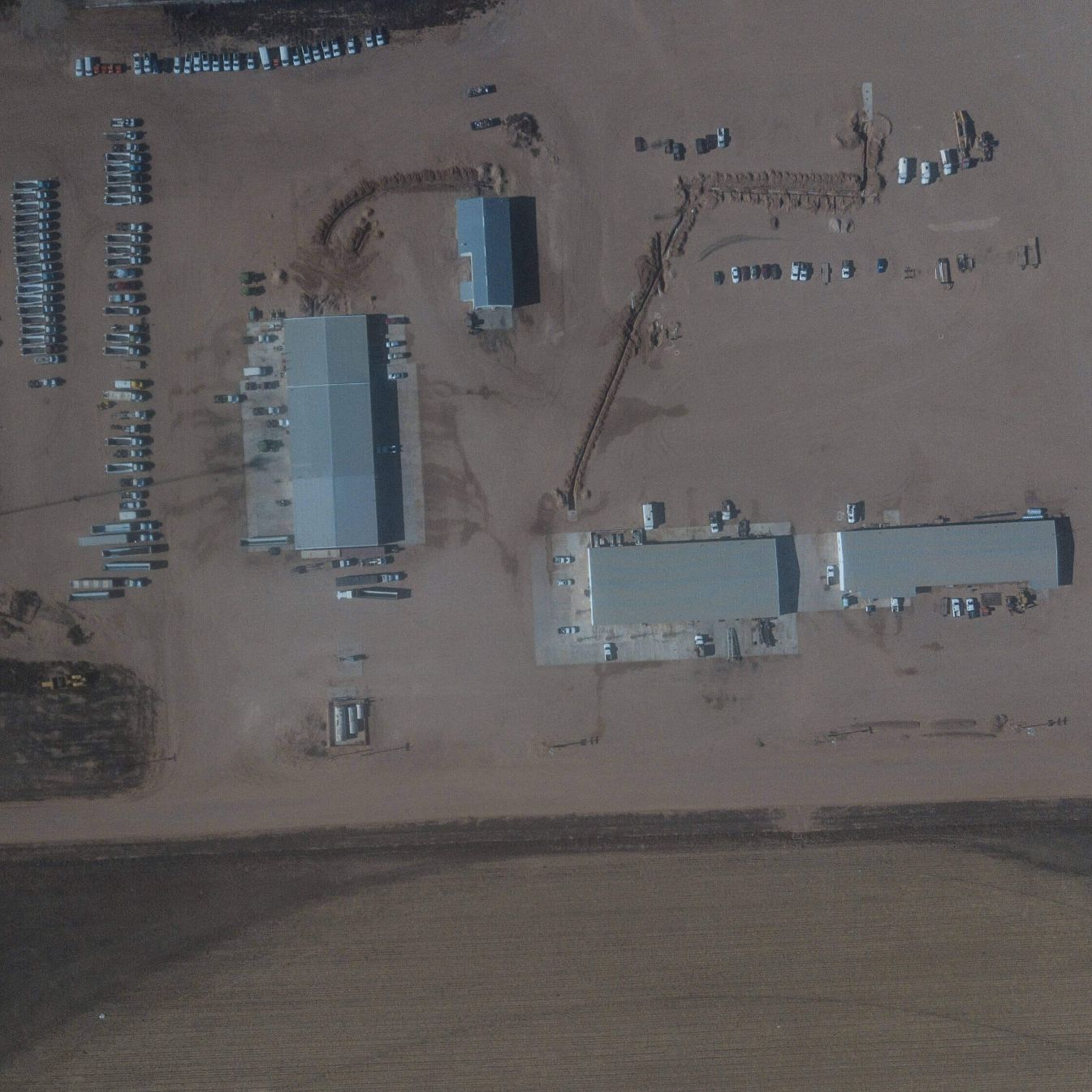
One of the workers who spoke to investigators explained that he was aware he would take to pay $one,500 to José Ramón Huaracha considering he knew the person who nerveless the money on Huaracha'southward behalf. He displayed text messages in which he discussed payments with some other person. He said that he and other H-2A workers discussed the fees they had to pay to piece of work at Larsen Farms while they were in a hotel in United mexican states waiting to travel to the United States.
Aerial view of the Larsen Farms white potato processor.Almudena Toral/Univision
Other employees said they and several family members paid between $1,000 and $1,200 to be included on the supervisor's list. I of them, identified as H-2A worker No.iv in the criminal complaint, was contacted directly past José Ramón Huaracha to discuss the chore opportunity and the "understanding that [the worker] would be 'helping' José Ramón Huaracha by making a $i,000 payment to him."
The Polaris Projection, which runs the National Human Trafficking Hotline and shares the data with the federal government, has learned in interviews with immigrants who work at a number of companies that fees charged for visas can be equally high as $5,000. The organization has prove that the practice is used in sectors including hotels, restaurants and domestic piece of work.
The Polaris report Labor Trafficking in the U.S.: A Closer Look at Temporary Piece of work Visas explains that fees are paid to recruiters, employers or direct supervisors for two reasons: to embrace the expenses of obtaining a visa or simply as a requirement for employment.
It details the abuses and fraud that immigrants experience starting from the moment they are offered a job—with promises that fade one time they arrive in the field: "Workers were given misinformation about wages, schedules, associated fees, living atmospheric condition, and benefits."
Co-ordinate to the Department of Homeland Security, collecting these fees is illegal and costs must exist assumed entirely past the employer: "A petitioner, agent, facilitator, recruiter, or like employment service is prohibited from collecting a job placement fee or other compensation (either straight or indirect) at whatever time from an H-2A worker equally a condition of employment."
Pablo was surprised to learn that this fee was illegal; he idea it was just part of the bargain. By 2020, he said that José Ramón Huaracha had increased his fee to more than than $ane,500. Other immigrants owed $i,800 or more, depending on the duration of their visas. "I don't call up in that location's anyone who comes hither without paying something," he says.
This isn't the offset time that Antonio Huaracha and Blaine Larsen have heard about the practise of charging for H-2A visas at Larsen Farms.
In a February 2020 interview, Antonio Huaracha acknowledged that he had heard of supervisors asking workers to pay "quotas" under the table in guild to get a temporary allow.
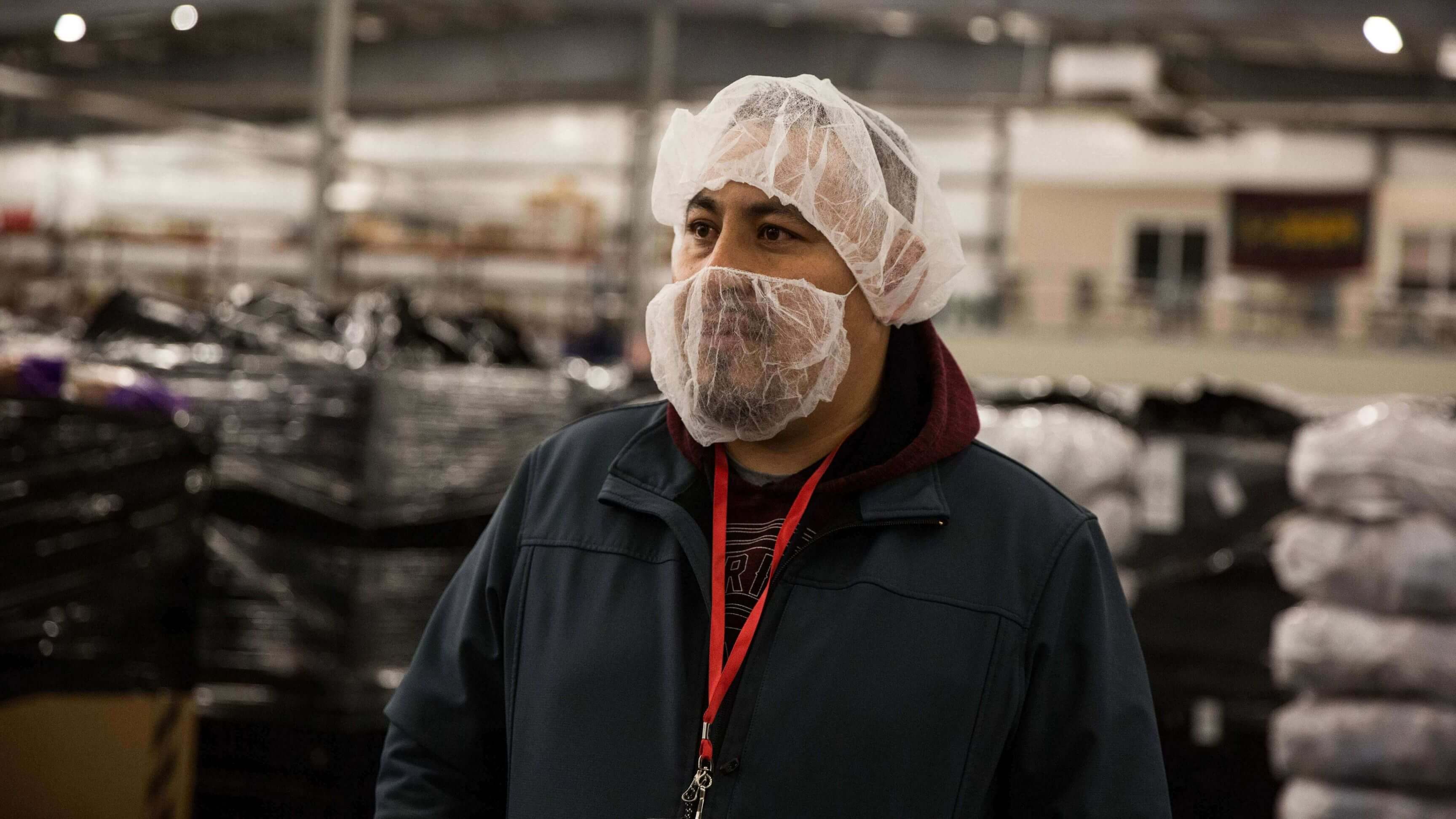
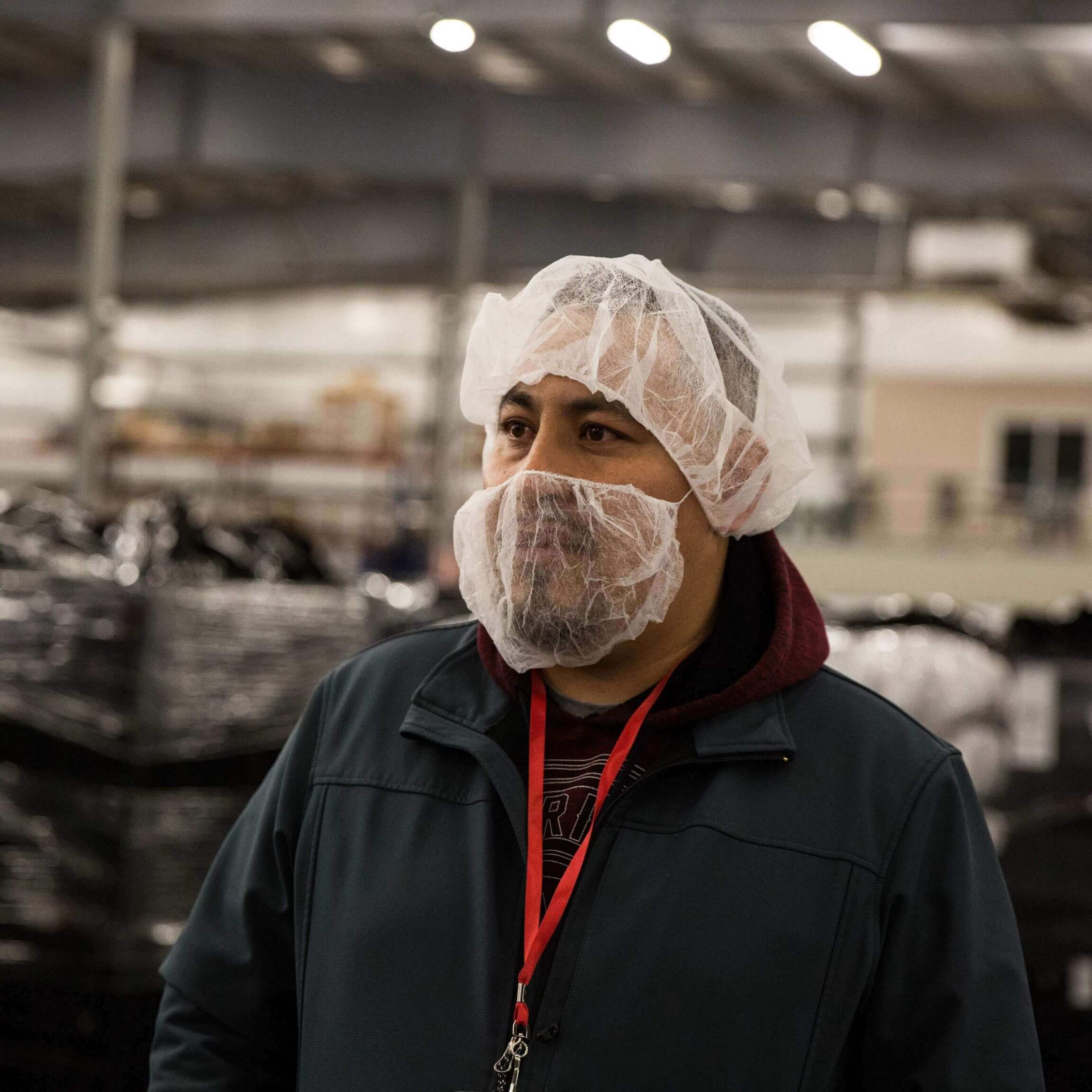
"We put a person [in Mexico] … to take intendance of getting people together, writing downwardly their names, lists, phone numbers and all that information," he said. "We needed someone to coordinate all of that."
Antonio Huaracha, the full general manager of Larsen Farms in Dalhart, at the company's warehouse. Almudena Toral/Univision
"So people began to complain: 'No, they're charging united states for this, that and the other,'" he recalls. "The trouble has e'er been in that location just I can't command that. It's something we tried to avoid, but I don't know."
While director of the plant in Dalhart for five years, he said that he e'er asked his highest-ranking employees—including supervisors, such as his blood brother José Ramón Huaracha—not to charge workers fees. "'Autonomously from the fact that it's not right, we're just going to create conflict and it's not going to end well for yous,'" he said he warned them. "I didn't think we were charging, simply as I said earlier, I'm not sure."
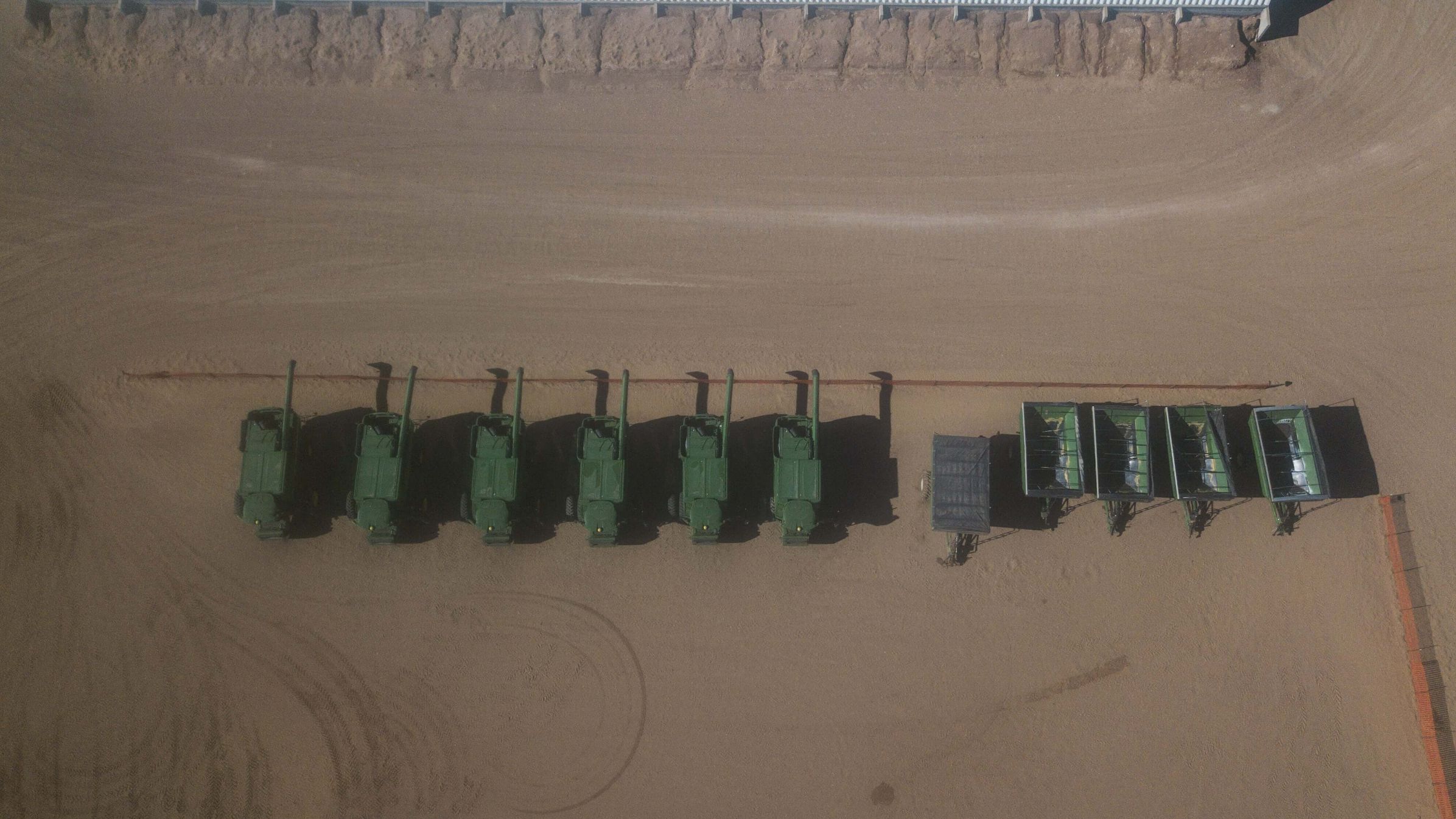
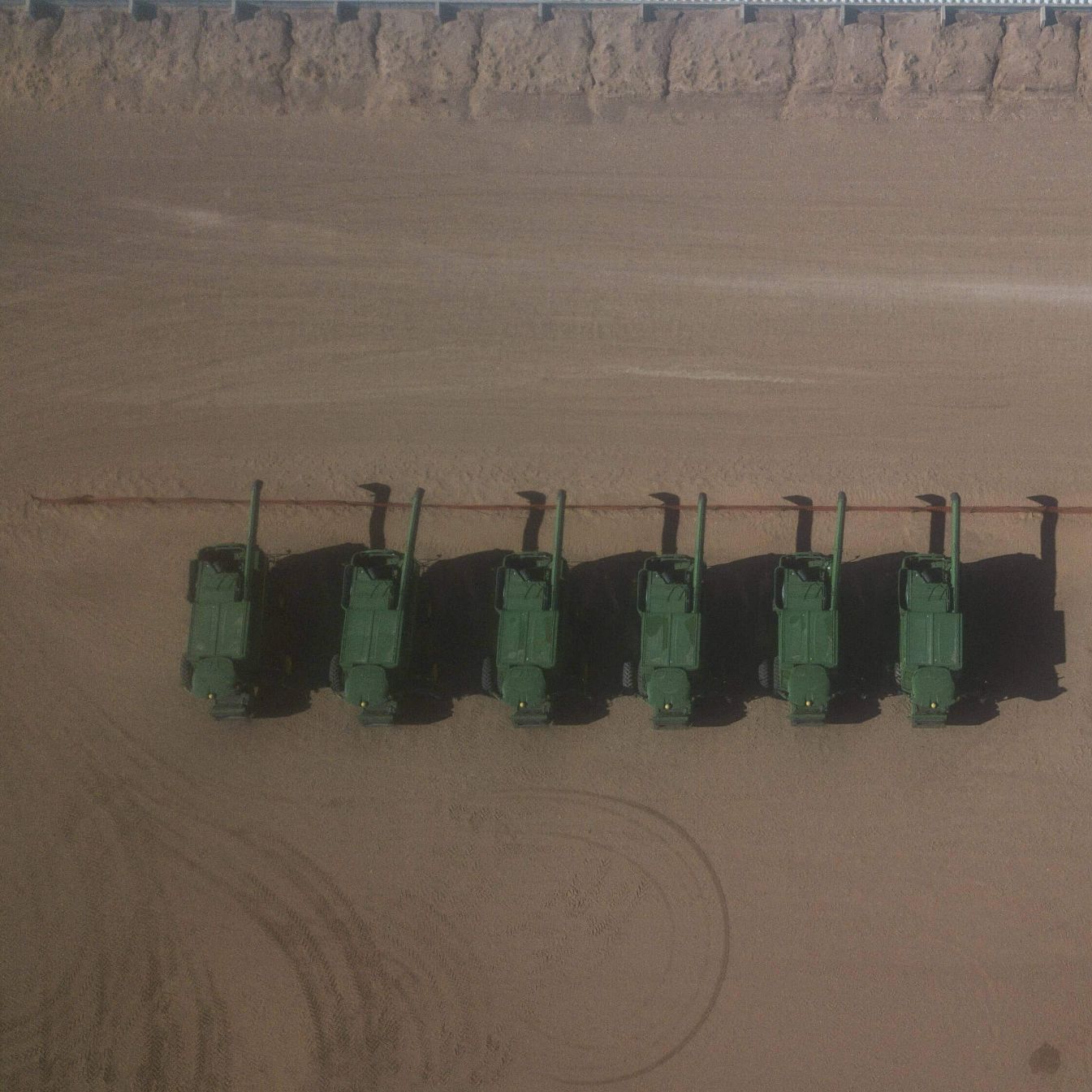
Huaracha said that's ultimately why he stopped the practice of having recruiters and allowed other employees to recommend people to their supervisors.
Hired workers come from Sinaloa, Sonora, Zacatecas, Jalisco, Veracruz, Michoacán and Guanajuato, where Antonio is from. He traveled to the United States when he was 20 years one-time after being recommended by cousins who were already at the Idaho potato processor; like José Ramón Huaracha, he besides came undocumented to work and help his family in Mexico.
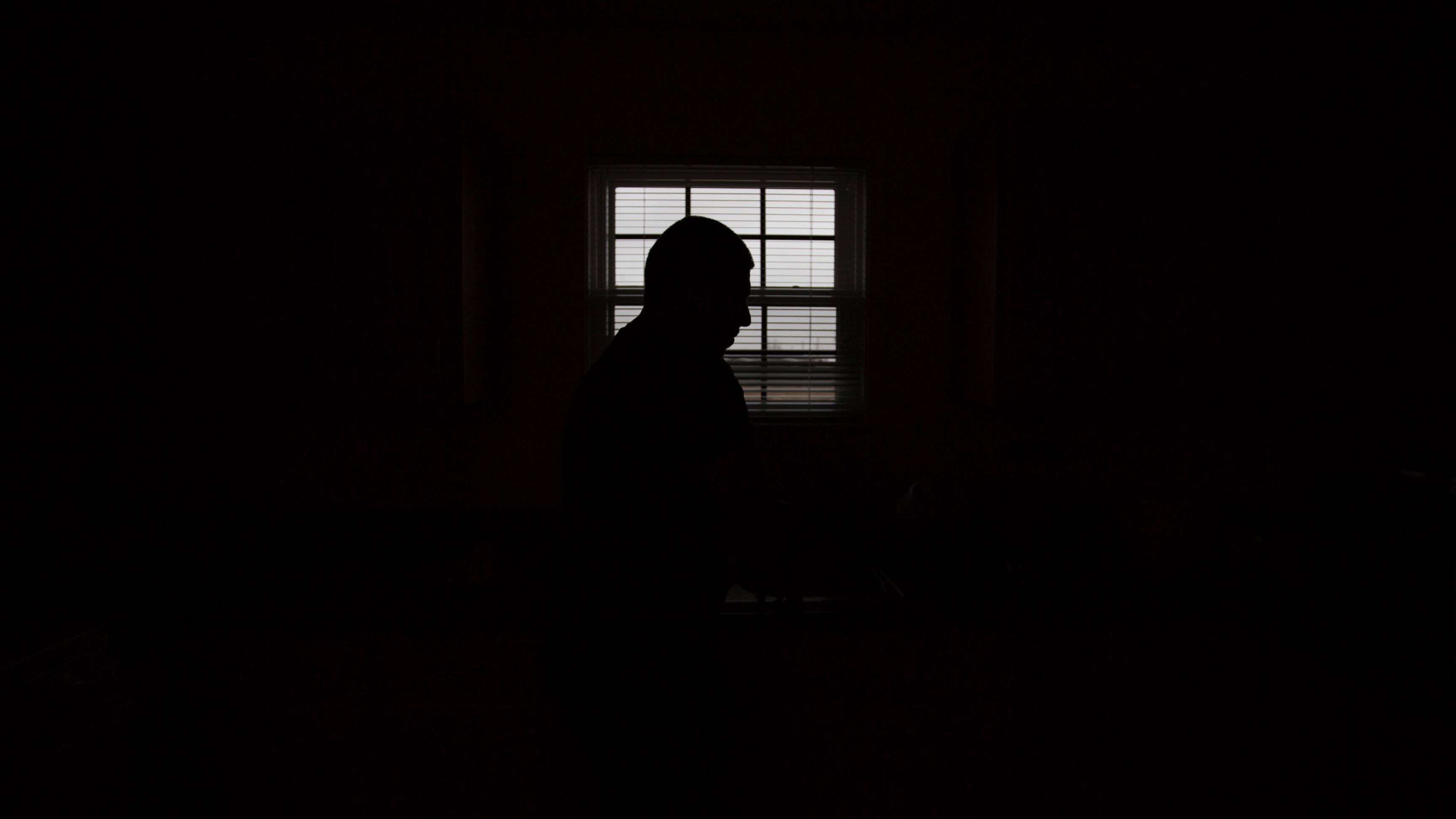
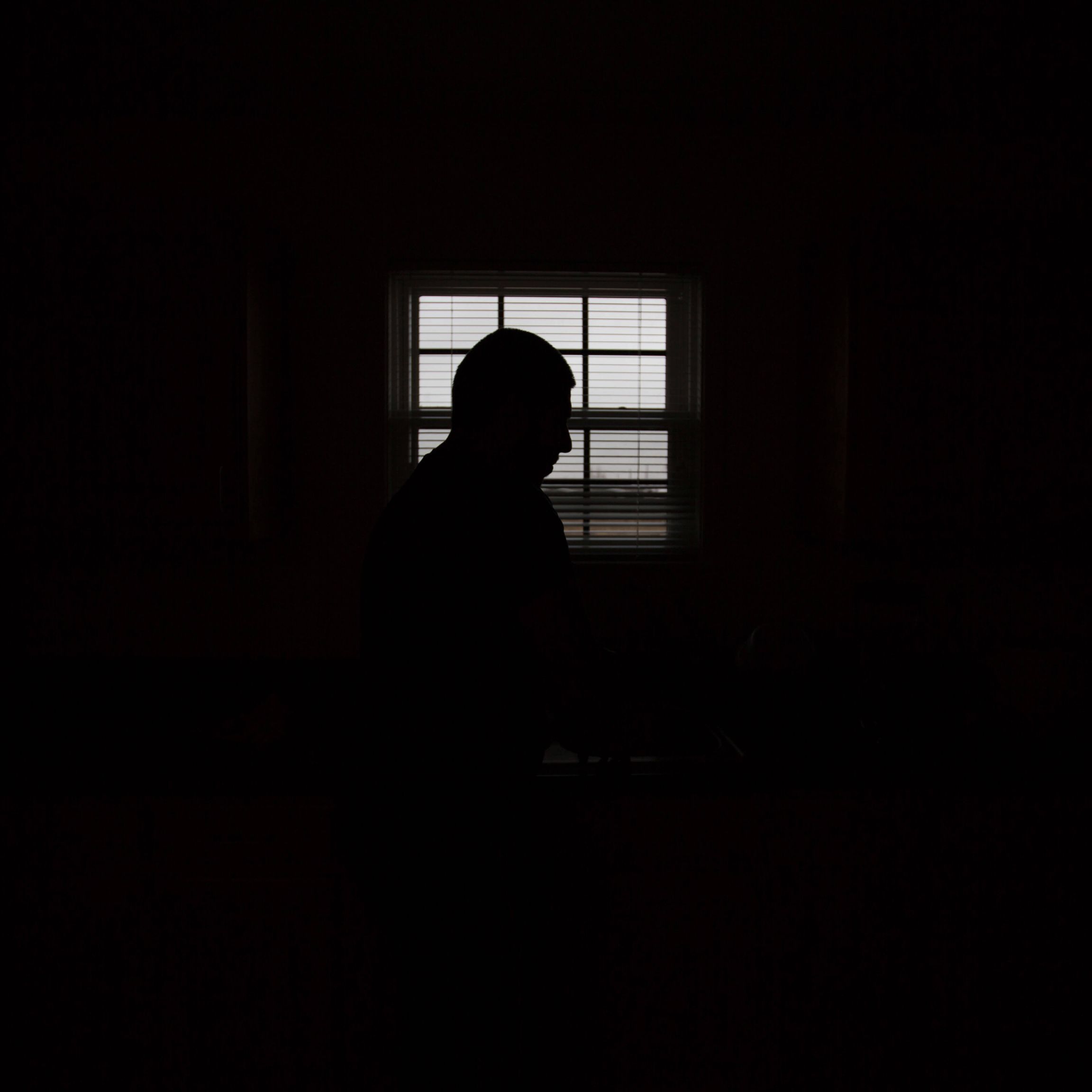
"Anyone who comes pays," explains this Mexican worker who used to piece of work at Larsen Farms and prefers to stay anonymous for fear of retaliation. "You pay the manager here." Although he was undocumented while working at Larsen, he has friends who held an H-2A visa and says everyone had to pay José Ramón Huaracha. If they didn't, they weren't brought back to work the following season.
Antonio Huaracha best-selling in a telephone interview in April 2020 that he had begun to pay closer attention to the rumors about his blood brother over the previous six months. "We have brought people here, to human resources, to enquire them if they participated in this blazon of deal, if they were charged to work. Until at present we haven't had luck with anyone."
The visitor's president, Blaine Larsen, also heard similar comments "possibly three to six years ago." So they resurfaced this jump. Recently, he tried to ostend the rumors amid employees: at least two people spoke to him near the matter, but no 1 presented show and therefore he didn't believe them. "I have a difficult time determining who is lying and who is telling the truth."
Co-ordinate to the criminal complaint, Larsen had asked his human resources managers to speak with some workers with H-2A visas: "Any of them willing to come forward with the truth about having to pay José Ramón Huaracha would exist automatically asked back to piece of work at Larsen in following seasons," it reads. But no one talked. Human being resources guessed that was due to fear.
"I would like to go to the bottom of this ... I have been investigating," Larsen said. "I tin can give you names, similar a woman who told me she had proof and never showed me evidence. And this was two years ago. The rumor has been there."
But he says he doesn't understand why workers are and so scared to denounce José Ramón Huaracha or the culture of fright in the company.
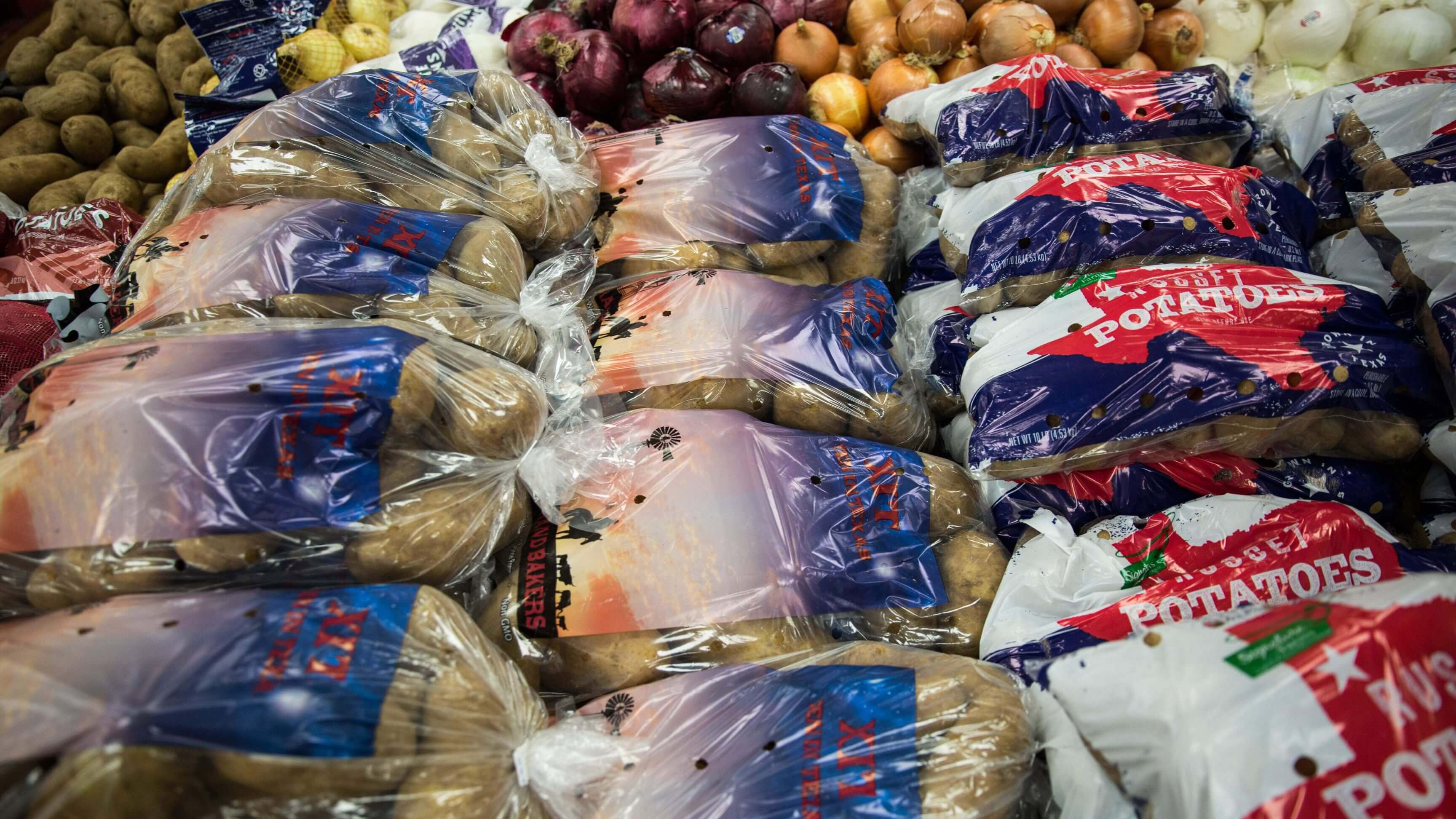

The potatoes sold at Walmart, United, HEB and other supermarkets may be packaged by Larsen Farms. Almudena Toral/Univision
"I can't believe Ramón went behind Antonio like that," Larsen said, exonerating the general director. "I think Ramón is dishonest and immoral, in my opinion. For me, Antonio and Ramón are like dark and day."
On several occasions, Larsen asked Univision to help him contact the sources cited in this report, promising there would exist no retaliation against the workers.
"Things would alter if someone showed me how to change them. I don't desire to exist the possessor of a company that has all these accusations against information technology," he said. "If people have to pay someone to be able to come work for me, if they are afraid in their workplace and cannot even become to the damn bathroom, what kind of deal is that? That's non a workplace, it'southward a prison house."
Subsequently José Ramón Huaracha resigned, Blaine Larsen formed a committee of supervisors and human resource managers to exist in charge of selecting H-2A workers. That fashion, decisions wouldn't be made by a unmarried person anymore, he said.
Victims also include those who claim to have been subjected to methods of economical control, similar being forced to pay debts for the cost of a visa to the United States, for example. Others had money taken out of their checks without explanation. Pablo says he experienced both at Larsen Farms, as did ix workers and one-time workers—including undocumented immigrants—that spoke to Univision Noticias.
A lawsuit against the potato processor filed in December 2015 exposed some of those abuses. Company agents had promised—by word of oral cavity—to pay three workers, José Duarte, José Ruiz Esparza and Jorge Ruiz, $15 an hr for 40 hours of work per week and $22.50 for overtime.
In the end they were fabricated to piece of work as truck drivers, forced to work during lunch without pay and were not paid fully for fourth dimension worked. "Accused Larsen did not pay the plaintiffs even the $seven.25 minimum wage or the promised overtime wage of $22.50 an hour," the lawsuit explains.
When Jorge Ruiz threatened to sue the leader of his team, Luis Huaracha—also office of Antonio's family—, Huaracha yelled at him. A day later Ruiz was fired past his supervisor Sergio Madrid. The complaint stated that it was a retaliation.


A Guatemalan Larsen Farms worker at his dwelling in belatedly 2019. This worker is i of multiple employees and former employees who say their checks came incomplete. After having worked at Larsen Farms for many years, in late 2019, his supervisor told him to come up just a few days a week. Several Guatemalans were fired because a new group of H-2A workers had arrived, they said. Almudena Toral/Univision
José Duarte was offered the same bacon, but i 24-hour interval one of his supervisors took him to the field, xxx miles from the plant in Dalhart, and informed him they wouldn't be paying him what they had offered. Instead, he would receive $x.50 an hour, a more than twoscore% reduction. He had to resign.
The company denied all such claims and the case was resolved with an agreement between the parties.
Outside of the lawsuit, Univision Noticias spoke with at to the lowest degree half-dozen people who merits that even bathroom breaks are express to ii per day. They also say that they receive warnings or are sent home without pay as punishment for drinking water during the day or wanting to rest when their shift is over, for receiving visitors that haven't been authorized by the company or for refusing to comply with an social club. Most of the interviewees implicated Xavier López Palacios, who ran the warehouse.
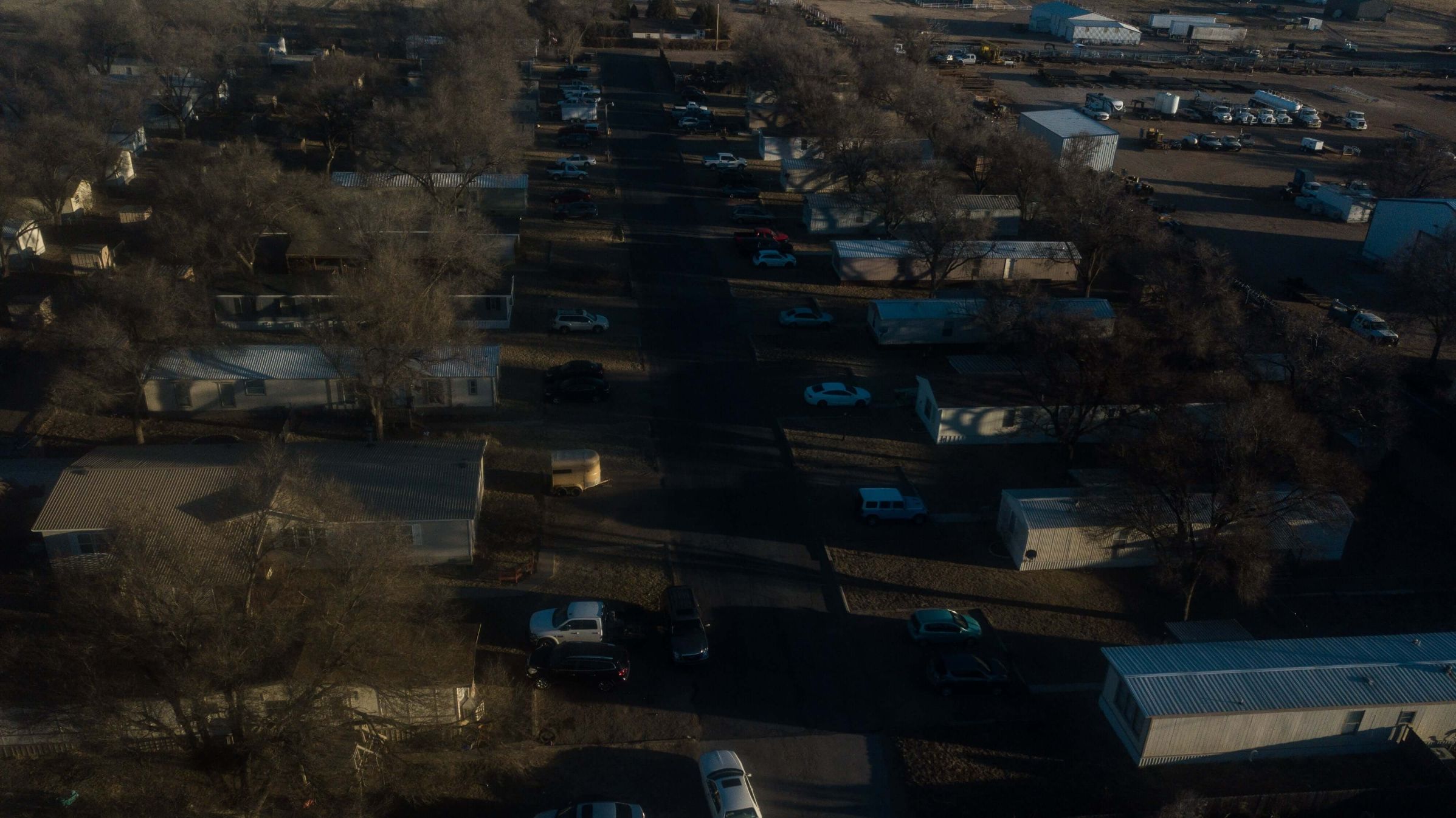
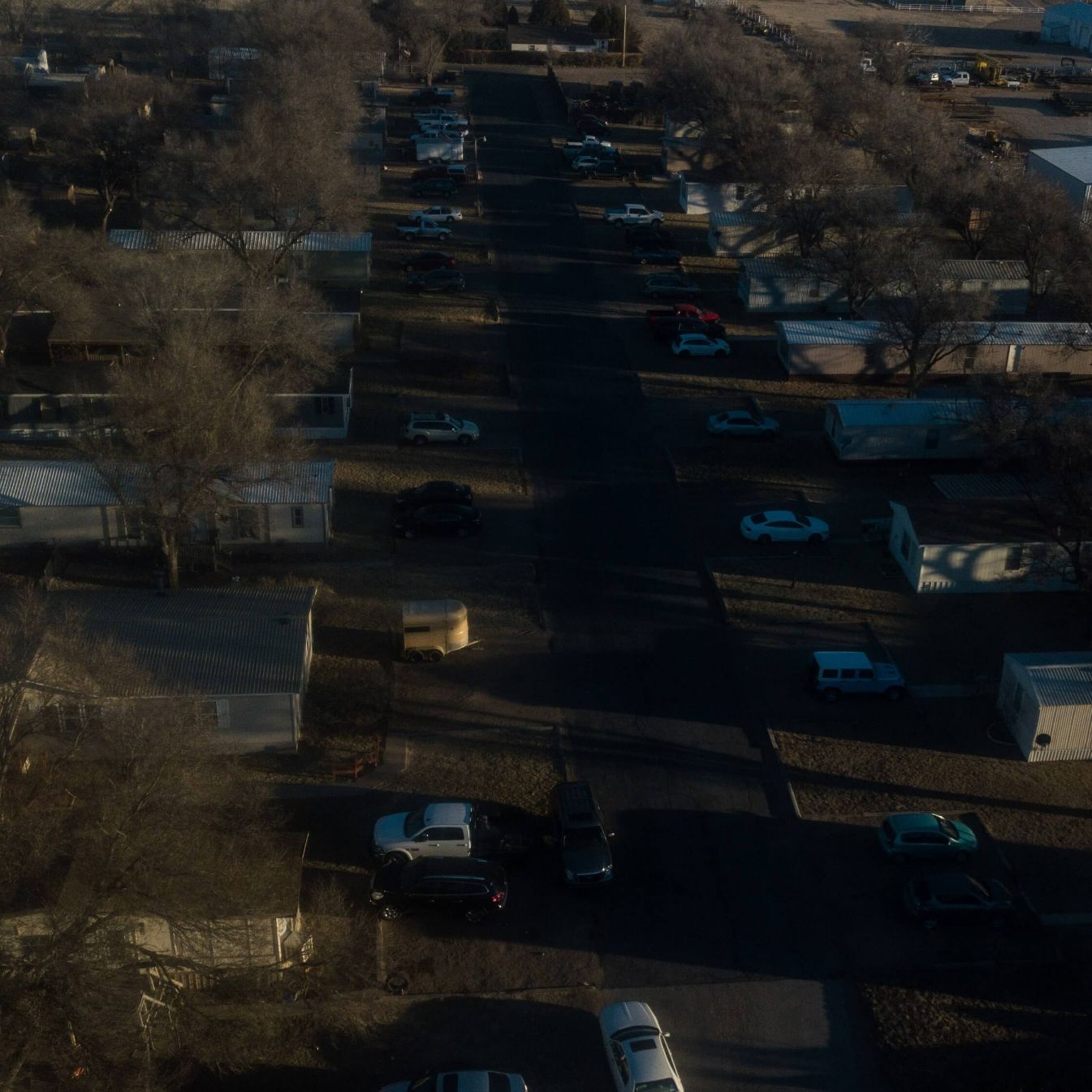
Larsen Farms' largest H-2A worker housing complex, where Pablo lives, is tucked in the middle of the field among trees and potato warehouses, a twenty-minute drive from the company'southward headquarters. This makes information technology difficult for workers to walk to the nearest town and seek aid.
Several employees with H-2A visas say they are observed by informants, who report their comings and goings to company bosses. Some accept received warnings as a consequence.
José Ramón Huaracha denied that claim. He says that he went to visit those in his care once a month: "Every time they reported that someone didn't come to practise the cleaning ... I went and spoke with that person [and so] that they would go to work, to do what they had to do."
Pablo says that they have a Larsen bus to shop at the closest Walmart, more than an hr from their homes. If they don't render on the same school autobus, they're punished.
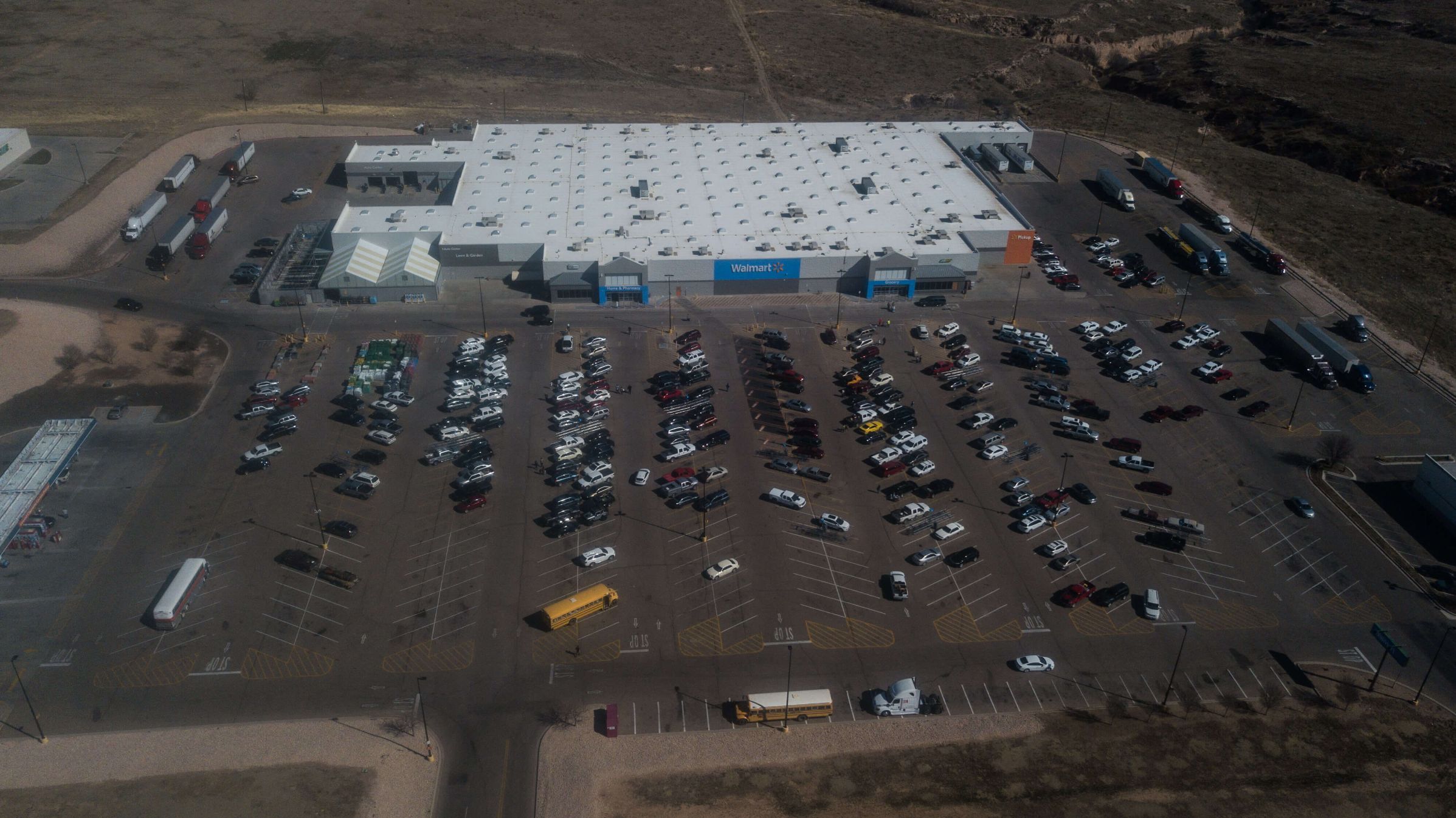

Two school buses used past Larsen Farms to take H-2A workers to the market are parked outside the Dumas Walmart on a Sunday morning. Almudena Toral/Univision
That vehicle is essentially the only ways they have to exit home on any given weekend.
The president of the company said he was "surprised" to learn of such abuses confronting employees and said he couldn't believe his supervisors acted in this style.

Palacios was fired in June. Larsen explained that several workers singled him out for sexual harassment and said he forced workers to requite him coin. In an interview in late April, the former supervisor denied these allegations to Univision: "That is totally false," he said.
On July 21, López Palacios was arrested and the U.S. Government charged him with fraud and misuse of visas, permits and other documents. The criminal complaint explained that he was using a false ID and social security number; his existent name is Gregorio Fernando López Martínez. He is now in the custody of Immigration and Custom Enforcement in Amarillo, Texas.
"Lopez Martinez admitted that he had presented [the documents] for employment at the business concern, that he knew they were counterfeit, and that he received them from a friend," the complaint reads.
There are no anti-trafficking activists or non-governmental organizations in Dalhart to assist immigrants. There aren't any pro bono law offices where workers can take a unproblematic consultation. The closest such help is in Amarillo, an hour and a one-half bulldoze south. But nigh no one knows who to call or where to get, and if they did, they don't have the time to make the trip.
They also don't trust the constabulary or the sheriff.
The Buffett-McCain Institute to Combat Modern Slavery is one of ii organizations beginning to delve into labor trafficking in the Texas Panhandle. A team of 4 people go directly to the homes and workplaces of subcontract employees to explain workers' rights and mind to their concerns. Not anybody opens the door, though.
Gonzalo Martínez de Vedia, plan manager of the organization, explains that the chances of a complaint for labor trafficking ending in favor of the victim are slim.

In the Texas Panhandle, he says, local police "don't have the resource or the noesis to sympathize that what is happening when someone reports that they were threatened or forced on the job is a federal crime."
Consequently, workers know that if they denounce, their exploiters volition not be punished.
In practice, the victims' lack of trust is clearly axiomatic in statistics from the Sheriff's Office in Dallam Canton, where Larsen Farms is located, and from the Dalhart Police force. Both say they oasis't dealt with a single reported case of labor trafficking.
Sheriff Shane Stevenson says his part but deals with reports of theft in homes and businesses, or drug crimes.
When their four agents get out to patrol, day or nighttime, they may accept one or two calls on such bug; never for complaints of forced labor or labor trafficking.
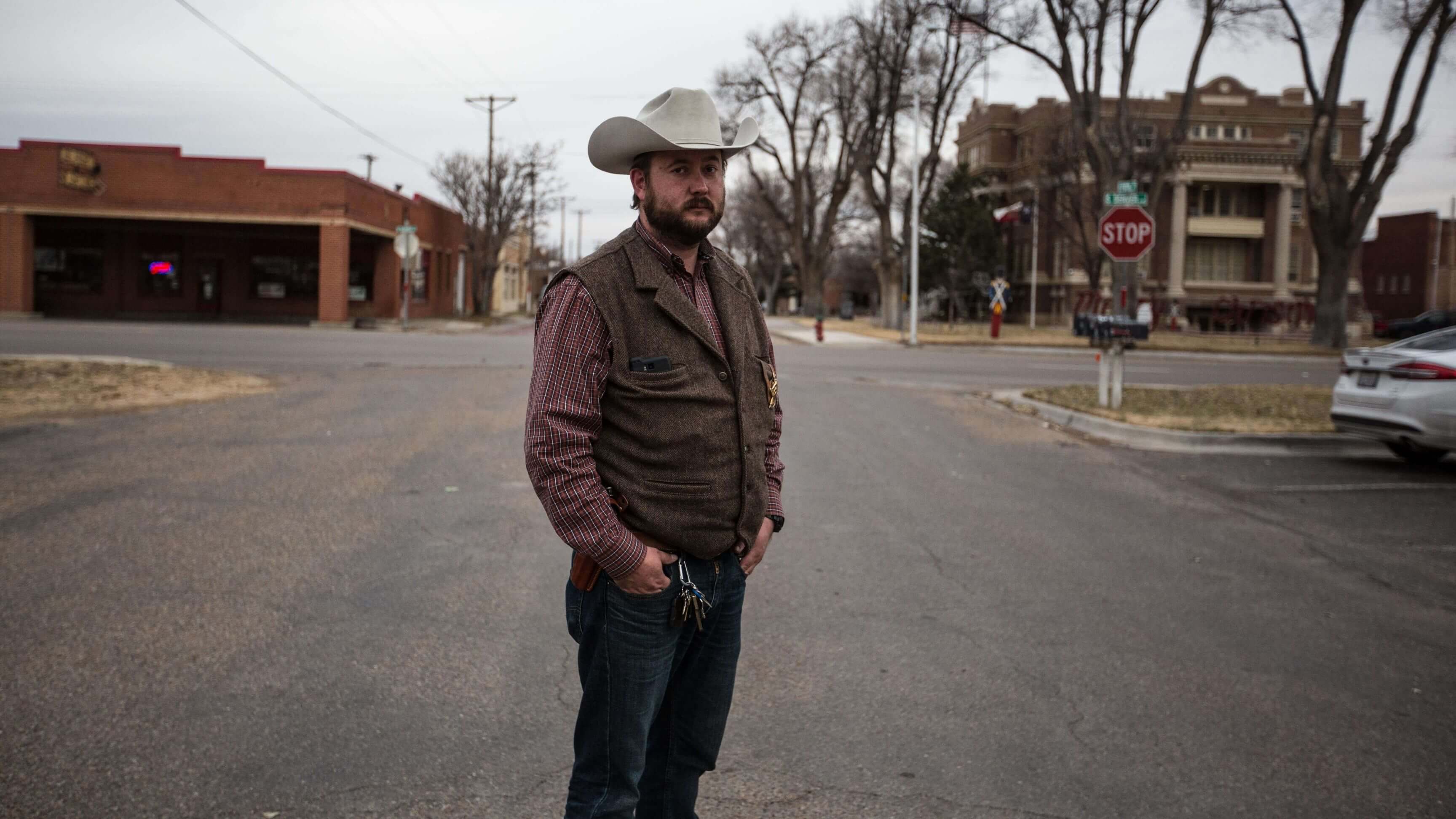
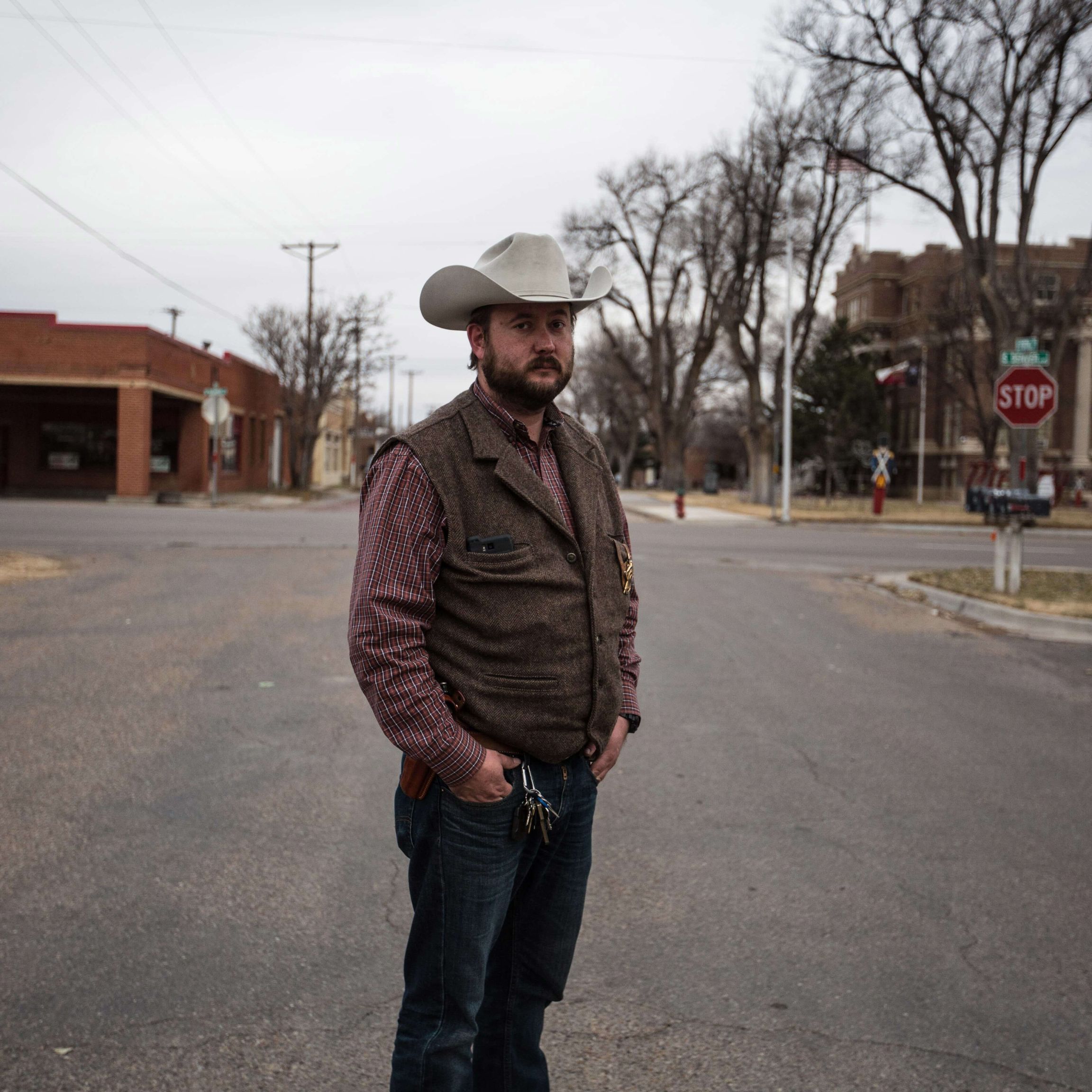
"At that place is no evidence showing that there's any type of forced labor, at least in Dallam Canton," says Sheriff Stevenson.
"If somebody is the victim of a crime, we desire to know about information technology. We're going to do everything we can to assist [them]. If they are undocumented, we'll treat them like anybody else."
Just the office would need at least 1 of their agents to speak or understand Spanish, and the person who did resigned a few months ago.
If someone makes an accusation and in the procedure of investigating the case officers notice the accuser is undocumented, they may contact Immigration and Community Enforcement (ICE) and transport the example to federal regime. At that indicate the immigrant could be at risk of deportation.
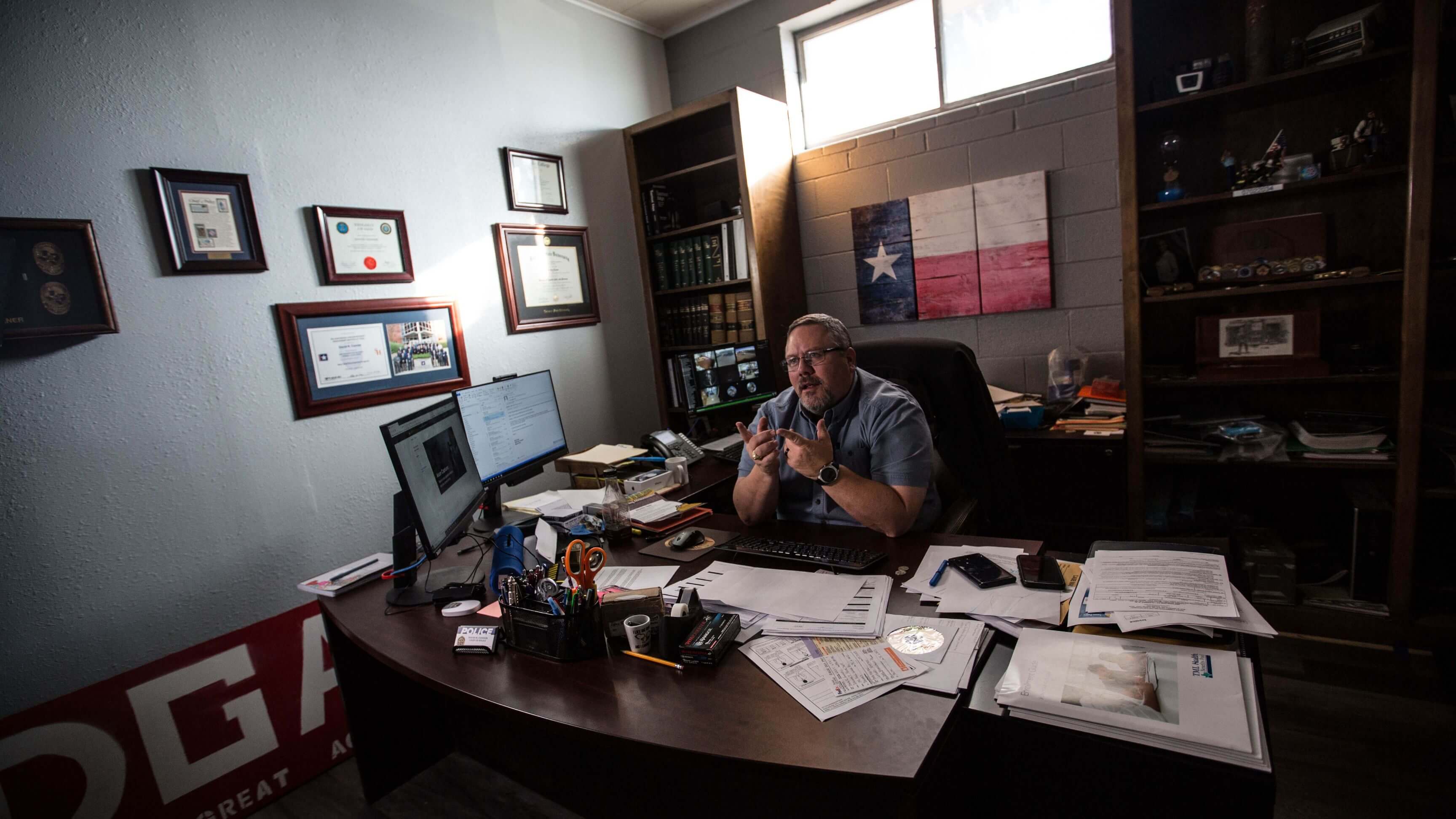
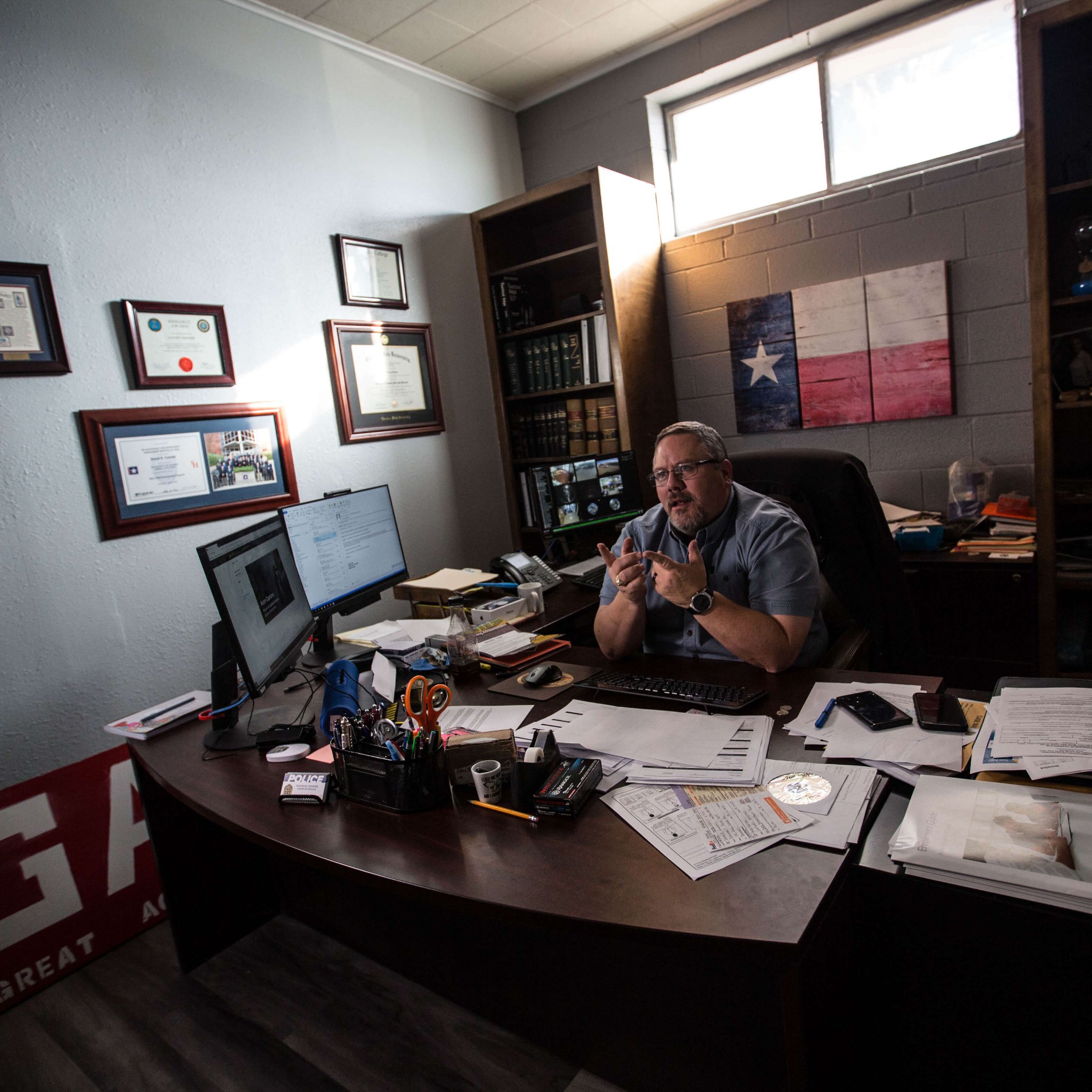
Dalhart Law Main David Conner says the fact that foreigners don't study crimes reflects the establishment's lack of credibility in the immigrant community.
Constabulary Principal David Conner in his Dalhart part. Almudena Toral/Univision
"The undocumented workers need to learn to trust us," says Conner, although he acknowledges that at that place's "a fine line because not only are we entrusted to enforce country law, we also have to abide by federal law."
If a person is a victim of labor trafficking and reports a crime, for example, the law volition asking documents to verify their identity. If the documents vest to another person, they tin request more than paperwork to verify the data. If the victim doesn't provide that paperwork, the police can call clearing authorities to have the person prosecuted for false documentation.
Law may also call immigration government if the person is undocumented.
That'southward how victims often cease up being the ones implicated past the justice system.
But Conner defends the practice, maxim state law simply requires him to verify a person's identity and that failing to do so could have consequences: "I'g non going to lose my chore."
For twenty years, Kirsta Melton worked as a prosecutor in San Antonio and until December equally deputy criminal affairs officer in the Texas Attorney Full general'south Office.
She challenges the police chief's position by explaining that when information technology comes to trafficking victims, federal and even country law has exceptions to protect these people and provide them with legal clearing status—a visa for victims of offense or human trafficking—while a instance is resolved, a process that tin can take years.
"A person'due south status is irrelevant to me every bit a prosecutor if a offense is being committed in my jurisdiction and I know I tin can practise something," she says. "My job is to seek justice for that victim."

She believes that the police officer's response demonstrates his inability to identify a criminal offense "every bit incredibly serious" as human trafficking.
"I think they are interpreting the law incorrectly," she says. "They don't see a victim of trafficking but someone who entered the country illegally and that's why they pass it forth to the federal immigration organization," she explains, pointing out that the outcome came up constantly while she worked as a prosecutor.
Instead of punishing the victim, she says, police should endeavor to obtain the greatest possible burden of prove to make up one's mind if a crime was indeed committed, to be able to initiate an investigation, codify a criminal or ceremonious case and thus "get the trafficker off the streets" and prevent him or her from exploiting more than people.
Pablo well-nigh reported his supervisor's abuse months dorsum, just over fourth dimension he changed his listen. In a higher place all, he just wants to protect his chore.
He has never discussed the upshot, not even with his family. At the United States consulate in United mexican states, where he got his visa stamped, he was given a paper with his rights and told that he could file a complaint. Only he didn't dare speak upwards when he returned the following year.


"If they find out I reported it I would lose my job, my opportunity," he says. "I prefer to go out information technology at that. That's why we adopt to put up with everything—the insults, mistreatment."
Katherine Porterfield, clinical psychologist with the Bellevue/New York University Program for Survivors of Torture, explains that those who are abused to the limit of trauma are "living in a condition of inescapable threat," from which the torso reacts by blocking fearful memories and losing the ability to inquire for help.
That's why it's so difficult for them to talk well-nigh what they experienced—or experience—during an investigation: "We can't really expect that people who've been through severe trauma will and then be able to speak upwardly and talk about it. Especially when they're still in a situation of ongoing threat."


María Basualdo, a psychologist who specializes in treating Latino immigrants who are victims of crime and trauma in the United States, points out the tremendous vulnerability of the Central American and Mexican immigrant population, precisely because many have already been victims in their land of origin.
That's the case with Pablo. "The trauma is cumulative, there are unlike injuries in different places. Each trauma opens the previous trauma," says Basualdo, pointing out that fear often produces paralysis. "If in that location is fear of reporting, there is corruption. If at that place is fear, there is trauma."
Pablo says he feels trapped at Larsen without his own space or the freedom to move around. Still, the opportunity to earn a salary in dollars makes him think he would still pay a visa "fee" to come up to the U.s.a..
Since April 19, when José Ramón Huaracha resigned, Pablo and other employees stopped paying their biweekly fee. Pablo continued to live in fearfulness of losing his task despite Huaracha's resignation and his abort by federal agents, along with the abort of Xavier López Palacios.
Only he still hasn't dared speak to investigators at the Labor Department. There is but one style he'd talk nearly everything he's been through: if authorities guarantee they volition remove him from Larsen Farms and give him shelter and protection while he continues to piece of work in the United States to support and protect his family.
For now, activists who have tried to offer him assistance cannot guarantee these protections. And so he has no other fashion to respond to the abuse except to work, in silence and resignation.
If you are suffering from whatsoever of the to a higher place situations and think yous are a victim of labor trafficking, you can contact the Polaris Project helpline at any fourth dimension past calling 1-888-373-7888.
A Univision Noticias Special
Reporting and production: Patricia Clarembaux and Almudena Toral
Text: Patricia Clarembaux
Photography and video: Almudena Toral
Graphics, illustration and animation: Mauricio Rodríguez Pons
Music and audio design: José Luis Osuna
Voice actor in the video: Onder Villalobos
Editing: Maye Primera
Digital Product: Hernán Cárdenas
Spider web pattern and development: Adriana Bermúdez and Juanje Gómez
Translation: Jessica Weiss
Special thank you: Santiago Marvez, Ronny Rojas and Patricia Vélez
Source: https://www.univision.com/especiales/noticias/2020/potato-slaves/index.html
0 Response to "Us Customs Prosecutes Family in Texas Over Potato"
Publicar un comentario